


Learning how to cut polycarbonate sheet cleanly is mostly about controlling heat. Polycarbonate is tough enough to stop a hammer, which is exactly why it fights a careless blade: rush the cut and friction melts the edge into a gummy, fused bead. Do it right and the same sheet cuts as cleanly as plywood with tools you probably already own. We cut polycarbonate to size every week at our North York warehouse, and this guide passes on what actually works, from blade choice to drilling without cracks, with real Canadian pricing at the end.
Key takeaways:
- The cleanest way to cut polycarbonate sheet is a circular saw or table saw with a fine-tooth carbide blade (60 to 80 teeth), fed at a steady pace so the blade never lingers and melts the edge.
- Use a jigsaw with a fine metal-cutting blade for curves and cutouts; use a router for the smoothest finished edge.
- Never score and snap polycarbonate. It is up to 30 times more impact-resistant than acrylic and will not fracture cleanly, which is the whole reason you bought it.
- Leave the protective masking film on through every cut and drill operation to protect the surface and reduce chipping.
- Drill holes 1 to 2mm oversize and avoid laser cutting, because polycarbonate expands with temperature and scorches under a laser.
What Tools Do You Need to Cut Polycarbonate Sheets?
You can cut polycarbonate with tools found in most Canadian garages and workshops. The single thing that matters more than the tool is the blade: a fine-tooth carbide blade designed for plastics or non-ferrous metals, never a coarse framing blade. Match the tool to the cut you are making.
| Tool | Best for | Blade or bit |
|---|---|---|
| Circular saw | Long straight cuts on 3mm to 9mm sheet | 60 to 80 tooth fine carbide |
| Table saw | Repeat straight cuts, square edges | 80 tooth triple-chip carbide |
| Jigsaw | Curves, cutouts, holes for fixtures | Fine-tooth metal-cutting blade |
| Router | Smoothest finished edge, templates | Straight carbide flush-trim bit |
| Fine hand saw | One-off cuts on thin 2mm sheet | Fine-tooth backsaw |
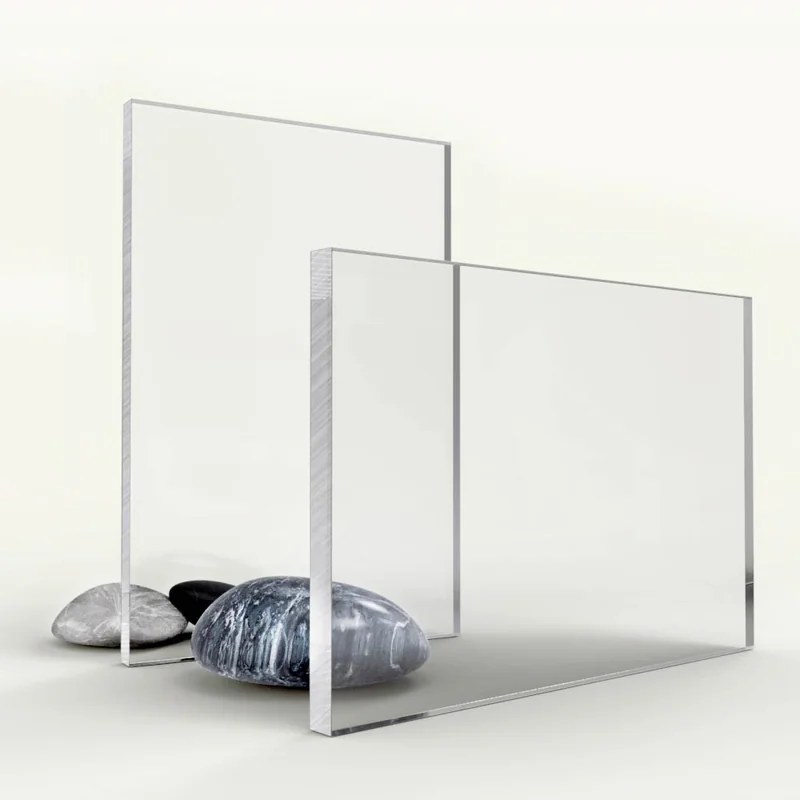
A few shop habits make every method better. Support the sheet fully on both sides of the cut line so it cannot vibrate or sag, because a flexing sheet chatters and chips. Clamp a straightedge as a saw guide rather than cutting freehand. And keep the masking film on the whole time, which protects the surface and gives you a clean line to mark on. Our solid clear polycarbonate sheet ships with masking on both faces for exactly this reason.


How to Cut Polycarbonate Sheets With a Circular Saw
A circular saw is the workhorse for straight cuts, and the technique comes down to blade choice and feed rate. Fit a fine-tooth carbide blade with 60 to 80 teeth, the same kind sold for cutting laminate or aluminum, and set the blade depth so it clears the underside of the sheet by only a few millimetres. A shallow blade depth means fewer teeth are in contact at once, which keeps heat down.
Feed rate is where most melted edges come from. The blade is spinning fast no matter what, so your job is to keep the sheet moving past it at a steady, confident pace. Too slow and the teeth rub instead of cut, building the heat that re-fuses the plastic behind the blade. Too fast and you chip the edge. Aim for the same steady push you would use cutting plywood, and let the blade clear its chips rather than packing them into the kerf.
Keep the masking film on, clamp a straightedge to guide the saw shoe, and back the sheet so it cannot sag. For sheets at 6mm and 9mm, a table saw gives a squarer cut because the fence holds the line for you. Manufacturers such as SABIC, maker of Lexan, publish the same advice in their sheet fabrication guidance: sharp carbide tooling and steady feed are what produce a clean cut. If you want the brand background on why Lexan and generic polycarbonate cut identically, our Lexan sheets guide for Canada breaks it down.
Want the cut done for you?
Send us your sizes and we will cut your polycarbonate to spec on our panel saw, square and burr-free, ready to install. No melted edges, no guesswork.
Get a free quoteHow to Cut Polycarbonate Sheets With a Jigsaw for Curves and Cutouts
When the job is a curve, a circle, or an interior cutout for a vent or fixture, the jigsaw takes over. Fit a fine-tooth blade, ideally one sold for cutting metal or plastic with a high tooth count, because a coarse wood blade tears the edge. Set the saw to a low or no orbital action, since aggressive orbital motion grabs the soft plastic and leaves a ragged line.

A fine metal-cutting blade and a slow feed give the jigsaw a clean curve without melting.
For an interior cutout, drill a starter hole first (more on drilling below), then feed the blade in from there. Mark your line on the masking film with a pencil, keep both hands steady, and let the blade do the work without forcing it around tight turns. As with the circular saw, a steady feed beats a fast one: ease off near the end of a cut so the offcut does not crack away and chip the corner. Thin 2mm and 3mm sheet cuts almost effortlessly this way, which is why fabricators reach for the jigsaw on custom machine guards and sign faces.
Can You Score and Snap Polycarbonate Like Acrylic?
No, and trying it wastes a sheet. Score-and-snap works on acrylic because acrylic is brittle: a scored line gives the sheet a fault to fracture along, and it breaks clean. Polycarbonate behaves the opposite way. It is up to 30 times more impact-resistant than acrylic and up to 250 times stronger than glass, so instead of snapping at a scored line it just bends, leaving a torn, useless edge.
This difference trips up people moving from acrylic to polycarbonate for the first time. If your project actually wants the score-and-snap workflow, you may be reaching for the wrong material, and our acrylic versus polycarbonate comparison for Canada walks through which one fits which job. The short version: choose acrylic for clarity, engraving, and easy cutting; choose polycarbonate when the part has to survive an impact. Always cut polycarbonate all the way through with a saw, jigsaw, or router.
How to Drill Polycarbonate Without Cracking It
Polycarbonate drills cleanly with ordinary twist bits, and two rules prevent almost every cracked hole. First, back the sheet with a scrap board clamped underneath so the bit exits into wood, not air, which stops the underside from blowing out. Second, run the drill at a moderate speed and ease off pressure as the bit breaks through.

Back the sheet with scrap wood and drill mounting holes 1 to 2mm oversize for thermal movement.
The detail that catches people out is hole size. Polycarbonate expands and contracts with temperature far more than glass or metal, so every mounting hole needs 1 to 2mm of clearance around the fastener. A tight hole that looks fine in a heated July shop becomes the start of a crack by February as the panel shrinks against a rigid bolt. The numbers are real: polycarbonate moves roughly 0.065mm per metre for every degree Celsius, so across a typical Canadian seasonal surface swing of about 60 degrees, a panel stretches and shrinks more than you would guess.
That movement is also why framed panels need a 3 to 5mm expansion gap at every edge, a point we cover in detail for overhead work in our polycarbonate roof panels guide. Account for the same expansion when you plan your cut dimensions, especially on long runs, the way our sheet sizes and thickness guide recommends sizing any plastic sheet to its frame.
Why You Should Not Laser Cut Polycarbonate
A laser is the wrong tool for polycarbonate, even though it is the best tool for acrylic. A CO2 laser cuts by burning, and polycarbonate burns badly: the edge comes out discoloured, brown, and rough instead of the flame-polished clear edge a laser gives acrylic. The process also releases harsh, acrid fumes that are unpleasant and hard on extraction systems. Fabrication guidance from polycarbonate producers such as Covestro, maker of Makrolon, steers users to mechanical cutting and routing for clean edges for this reason.
If a clean machine-cut edge is the goal, a router with a flush-trim bit and a template gives the smoothest finish of any method, better than any saw. Reserve the laser for acrylic, where it shines: our laser cutting acrylic guide for Canada explains why the two materials behave so differently under the beam. The wider industry context on thermoplastic processing is catalogued by the Plastics Industry Association, which maintains standards documentation for polycarbonate and related materials.
What Are the Most Common Mistakes When Cutting Polycarbonate?
Most ruined sheets come down to the same handful of errors, and knowing how to cut polycarbonate sheet well is partly about knowing what not to do. We hear about these from customers who come in for a second sheet after the first one went wrong:
- Using a coarse wood blade. A framing blade with 24 to 40 teeth grabs and chips the soft plastic. A fine 60 to 80 tooth carbide blade is the difference between a smooth edge and a mangled one.
- Feeding too slowly. Hesitation is the enemy. A slow feed lets the blade rub and heat the cut zone until the plastic melts and re-welds behind the blade. A steady, confident pace keeps the chips clearing.
- Peeling the masking film early. Customers often strip the film to "see what they are doing," then scratch the surface on the bench. Mark and cut through the film, and peel it only at the end.
- Drilling holes too tight. A snug hole looks neat in summer and cracks in winter as the panel shrinks. Always drill 1 to 2mm oversize for movement.
- Cutting an unsupported sheet. A sheet that overhangs the bench flexes and chatters, chipping the edge and risking a cracked corner. Support both sides of the cut line.
Get those five right and the rest of the job is easy. None of them need special equipment, just attention to the feed rate and the masking film.
How Do You Sand and Finish a Cut Polycarbonate Edge?
A saw-cut polycarbonate edge usually has light burrs or saw marks that you will want to clean up, especially on a visible part or anywhere hands will touch. Start by knocking off the sharp corners with a fine file or a deburring tool run lightly along the edge. Then sand progressively: begin around 120 grit to remove the saw marks, step up to 240, then 400, and finish with 600 grit used wet for the smoothest result.
One honest expectation to set: unlike acrylic, polycarbonate does not flame-polish or buff back to optical, water-clear edges easily. Acrylic shines up with a flame or a buffing wheel, while polycarbonate tends to hold a satin edge. For most machine guards, glazing, and signage that is perfectly fine, because the edge sits in a frame. When you do want the clearest possible edge, careful wet-sanding through the grits and a plastic polish gets you close. The same edge-finishing logic applies across plastics, and our acrylic and polycarbonate comparison explains why the two materials finish so differently.
A word on safety, since these are power tools cutting a tough material. Wear eye protection, because polycarbonate chips fly, and work in a ventilated space. Keep the sheet clamped and supported so it cannot kick back, and let the saw reach full speed before it touches the plastic. None of this is exotic, but a chipped 9mm sheet at $325.41 is an expensive reminder to slow down and set up properly.
What Does It Cost to Buy and Cut Polycarbonate in Canada?
Cutting your own makes the most sense when you buy full sheets, because cut-piece pricing at hardware chains runs two to three times the per-square-foot cost of a full 4x8 sheet. Our live North York warehouse pricing on solid clear polycarbonate runs from $82.41 CAD for 2mm to $325.41 CAD for 9mm, all in the standard 4x8 ft format:
| Thickness | Price (CAD per 4x8 ft sheet) | Typical cutting tool |
|---|---|---|
| 2mm | $82.41 | Jigsaw or fine hand saw |
| 3mm | $94.41 | Circular saw or jigsaw |
| 4.5mm | $120.41 | Circular saw |
| 6mm | $185.41 | Circular saw or table saw |
| 9mm | $325.41 | Table saw |
A full 4x8 sheet is 32 square feet, so 6mm works out to about $5.80 per square foot before you make a single cut. If you only need a couple of small parts, the math still favours buying the sheet and keeping the offcuts for brackets, spacers, and test cuts to dial in your feed rate. If you would rather skip the dust, we cut to size on our panel saw and you can request a cut-to-size quote with your exact dimensions.
Buying polycarbonate to cut yourself?
Get a same-day quote on solid clear sheet from 2mm to 9mm, with volume pricing on 10+ sheets and freight across Canada from our North York warehouse.
For the full material background, including impact ratings, UV protection, and where each thickness fits, our complete polycarbonate buyer's guide for Canada covers the resin itself in depth, and the full polycarbonate range shows everything we stock.
Where to Buy and Cut-to-Size Polycarbonate in Canada

A sharp fine-tooth blade and a steady feed produce a clean, burr-free polycarbonate edge.
Whether you cut it yourself or have it cut, start with a supplier who can tell you the sheet's thickness tolerance and which side carries the UV layer, the two questions our guide to choosing a plastic sheet distributor in Canada puts at the top of the list. We stock solid clear polycarbonate in all five thicknesses at our North York warehouse, with masking on both faces, warehouse pickup, same-week Ontario delivery, and freight across Canada. We also keep single-sided frosted polycarbonate and diffused white polycarbonate for lighting and signage work, both of which cut the same way as clear sheet.
Prefer to talk it through? Call us at +1 (416) 857-7555 — real answers from the warehouse floor.

TORONTO WAREHOUSE Unit 29, 601 Magnetic Drive, North York, ON, M3J 3J2
Phone: +1 (416) 857-7555 Office: +1 (416) 726-2428 Sales: +1 (647) 919-7557 Email: info@fidarsystem.com
Frequently Asked Questions
Written by
Red Seal Fabricator · 15 yrs hands-on experience
James is a Red Seal certified fabricator with 15 years of practical experience cutting, shaping, and installing acrylic, PVC, and composite panels. He writes practical, tool-in-hand guides for sign shops, fabricators, and serious DIYers who want real answers from the shop floor.
Reader Reviews
Loading reviews…