

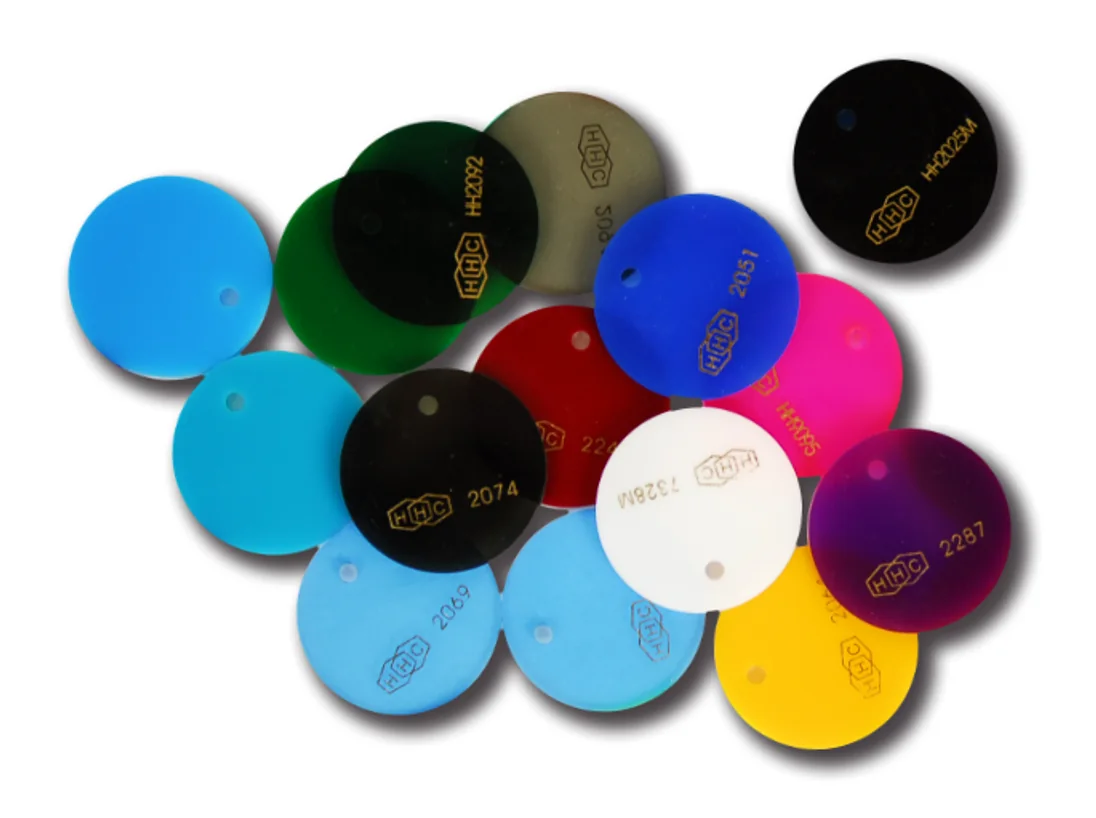
Pull the masking off a sheet of coloured cast acrylic on our floor and you will usually find a small gold hexagon with three letters inside it, and a number beside it. Most people never look. The number is not ours. It was assigned in a factory in a town called Fangliao, at the southern tip of Taiwan, by a company that has been pouring acrylic between sheets of glass since the spring of 1973.
That company is Hsin Hwa Chemical, and HHC acrylic is what it makes. We are its exclusive distributor in Canada, which is a sentence that appears on a lot of supplier websites and means very little on its own. What follows is the part that can be checked: what the manufacturer publishes about its own product, where those numbers come from, and which of them actually change a decision on a Canadian bench.
Who makes HHC acrylic, and where
Hsin Hwa Chemical Co., Ltd. was established in the spring of 1973 with, in its own words, "a promise to become one of the top CAST ACRYLIC SHEET manufacture in the region." The plant sits at No. 1 Yung-Hsiang Road in Fang-Liao, Pingtung County, inside the Pingnan Industrial Park. In Chinese the company registers as 宏萊實業股份有限公司, Taiwan business number 76025023, which is worth writing down: it is the name on the paperwork if you ever need to verify the entity rather than the brand. That number resolves to the same Fangliao address in the Taiwan company register, which is how we checked it.
Pingtung is farm country. It is not where you would expect to find a sheet plant with a global order book, and the company is direct about why it works: Kaohsiung. The port of Kaohsiung is roughly an hour up the coast and is the largest container port in Taiwan, which is how a factory in a rural township reaches Rotterdam, Long Beach and, eventually, a rack in North York.
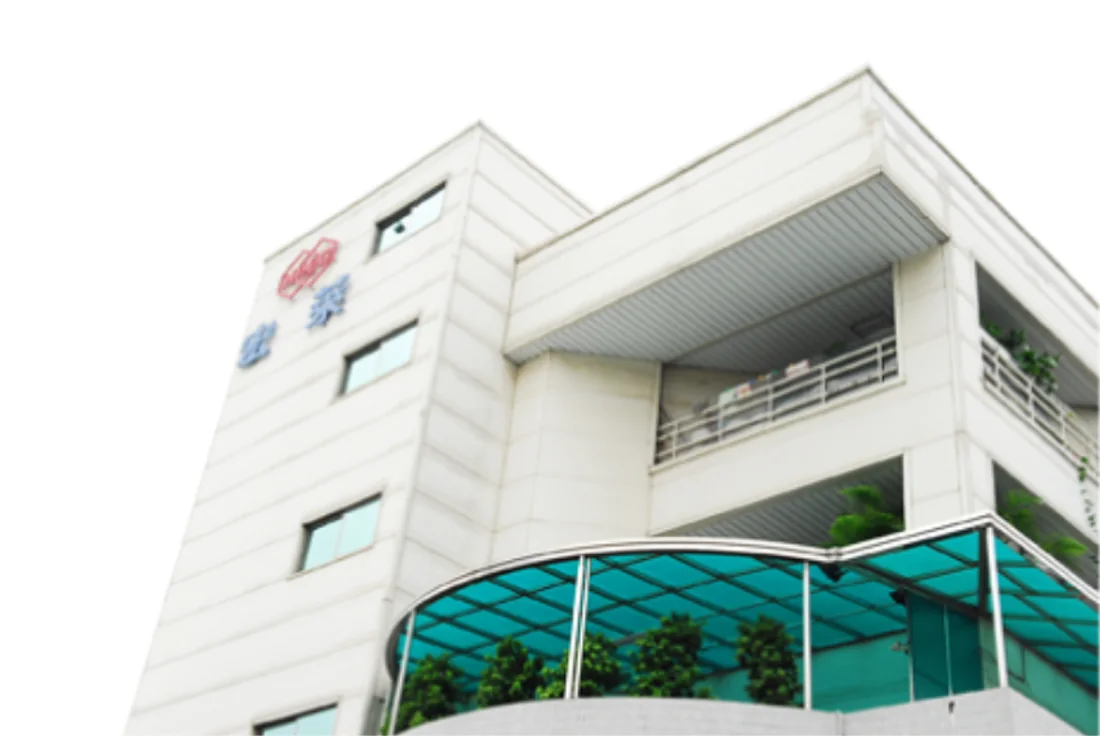 The plant in Fangliao, Pingtung County. The company has cast acrylic on this site since 1973 and ships through Kaohsiung, about an hour north.
The sheet itself is sold under a product name most Canadian buyers never hear, because it does not survive the trip through a distributor's catalogue: Beauty Glass. That is what Hsin Hwa calls its cast acrylic, and the phrase shows up on the company's own test documents, including the light transmission curve it publishes for clear sheet at 3mm, 5mm and 10mm.
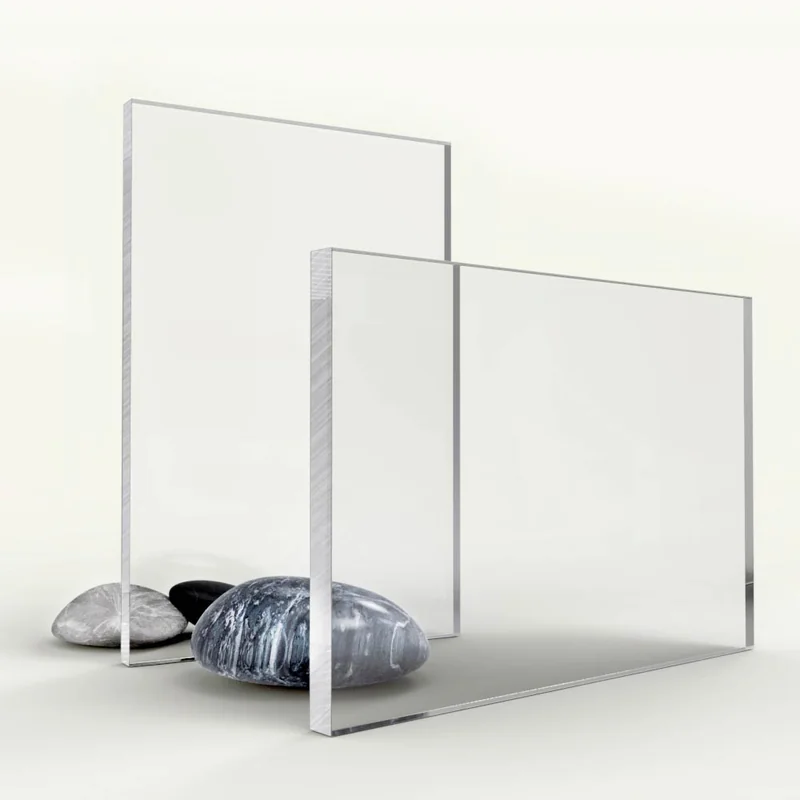
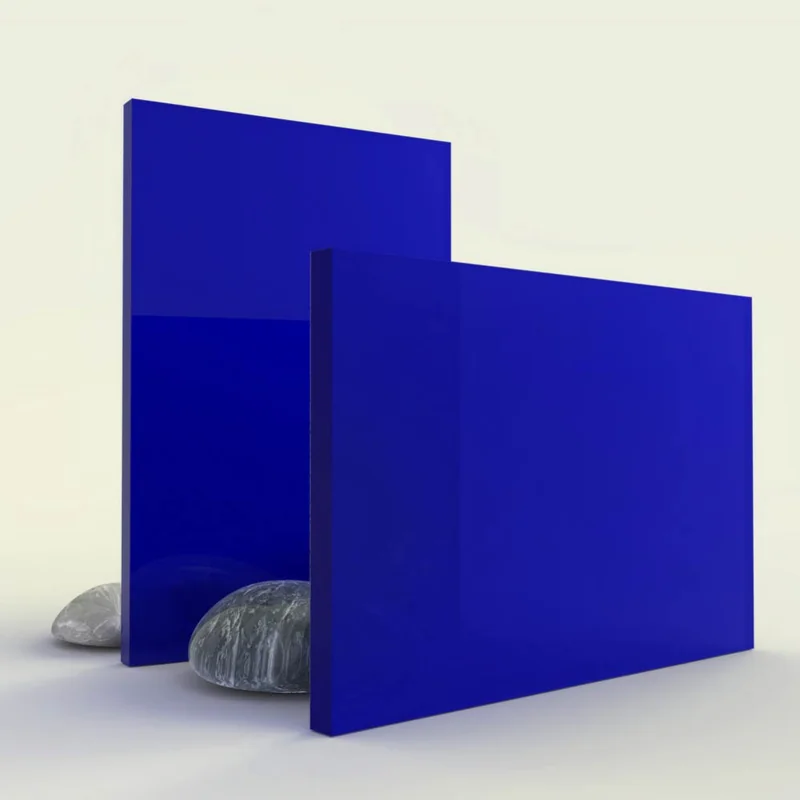

The code on the sheet is the factory's, not ours
Here is the detail that changes how you order. When you buy Blue 2051 or Black 2025M from us, that number was not invented in Ontario. Hsin Hwa publishes 52 colour codes on its product page, running from HH-000 for clear through HH-9092, and the number after the HH prefix is the code that ends up stamped on the chip and printed on our SKU.
Eight of the codes we carry appear verbatim on the manufacturer's public list: 504, 2016, 2030, 2037, 2051, 2114, 3199 and 9092. Look closely at the photograph at the top of this article and three of the codes we stock are legible on the chips: the blue 2051, the black 2025M and the violet 2287. Others in the same frame belong to the wider range rather than to our racks, including the black 2074 and the white 7328M, the latter being the matte designation of the 7328 white we do carry.
That continuity is the practical benefit of buying from a single caster rather than whatever container landed cheapest. A code is a formulation. Reorder 2051 in eighteen months for the second phase of a store rollout and you are asking the same plant for the same recipe, not asking a trader for something that looks close under warehouse lighting.
There is a second range worth knowing about. Hsin Hwa builds five Day and Night codes, C01M through C05M, engineered so a backlit sign reads as one colour in daylight and a different colour when the LEDs come on behind it. One sign, two identities, no second face. We stock C01M as a dual sided translucent black, which is the one sign shops ask for by name.
Not sure which colour code you are matching?
Send us the code, a photo of the old panel, or the brand standard. We will pull the chip from stock and tell you honestly whether it matches before you commit to a run.
Get a free quoteWhat HHC acrylic tolerance actually means
Cast acrylic is made by pouring liquid MMA monomer into a mould formed by two sheets of glass and letting it polymerise slowly. That process is what gives cast sheet its optical clarity, its clean laser engrave and its higher heat deflection temperature. It also means the sheet is never perfectly uniform in thickness, because the glass moulds are not a calibrated roller.
Every honest cast house publishes a tolerance for this. Hsin Hwa publishes one for every gauge it makes, and the shape of that table is more interesting than the individual numbers:
| Gauge | Published tolerance | As a percentage |
|---|---|---|
| 1.5mm | ±0.22mm | ±15% |
| 2.0mm | ±0.30mm | ±15% |
| 2.5mm | ±0.25mm | ±10% |
| 2.8mm | ±0.22mm | ±8% |
| 3.0mm | ±0.24mm | ±8% |
| 5.0mm | ±0.40mm | ±8% |
| 6.0mm | ±0.48mm | ±8% |
| 10.0mm | ±0.80mm | ±8% |
| 12.0mm | ±0.96mm | ±8% |
| 15.0mm | ±1.20mm | ±8% |
| 40.0mm | ±2.00mm | ±5% |
| 50.0mm | ±2.50mm | ±5% |
From 2.8mm all the way to 15mm the band is exactly 8 percent of nominal. Not approximately: multiply any gauge in that range by 0.08 and you get the published figure to the second decimal. The thin end is looser in percentage terms, 15 percent at 1.5mm and 2.0mm, because holding a fifth of a millimetre across a 2440mm pour is genuinely hard. The heavy blocks tighten to 5 percent, though above 50mm the published figure caps at a flat ±4.00mm rather than following the percentage down.
Where this bites is joinery, not optics. A 5mm sheet that arrives at 4.65mm still reads as clear, flat, perfect acrylic, and it will still drop straight through a slot you routed at 5.0mm. If you are building anything that press fits, cut the slot to the sheet in front of you rather than to the number on the invoice. We measure the actual gauge on request before a cut run leaves our floor, precisely because the published band is real.
The arithmetic gets uncomfortable when parts stack. Four sheets of 5mm laminated into a block are nominally 20mm, but the published band allows anywhere from 18.4mm to 21.6mm, and a captive frame machined to 20mm will not accept the high side. Fabricators who build layered work order a little extra sheet and measure the stack rather than trusting the sum, which is the sort of thing nobody tells you until the second time it happens.
This table is also the source of the tolerance our own cast acrylic pages quote, gauge by gauge. It is not a marketing number we chose. It is the manufacturer's table.
One sheet format runs the entire range
Hsin Hwa lists 18 sheet formats for gauges from 1.5mm to 12mm, from a modest 915 by 1830mm up to a 2030 by 3050mm panel. Then it publishes a second, much shorter table for heavy sheet, 15mm and up. Comparing the two turns up something a Canadian buyer should care about.
Every other format in that table stops at 25mm or below. The 1220 by 2440mm sheet keeps going: 30, 35, 38, 40, 45, 50, 60, 65, 70 and 75mm. It is the only format in the catalogue that runs the complete range, from 2mm sign face to a 75mm block.
That format is 48 by 96 inches. It is the North American standard sheet, the one our racks are built around, the one our nesting software assumes, and the one you can order cut to size online. If your part needs to come out of something thicker than an inch, it is coming out of a 4 by 8, wherever in the world you buy it.
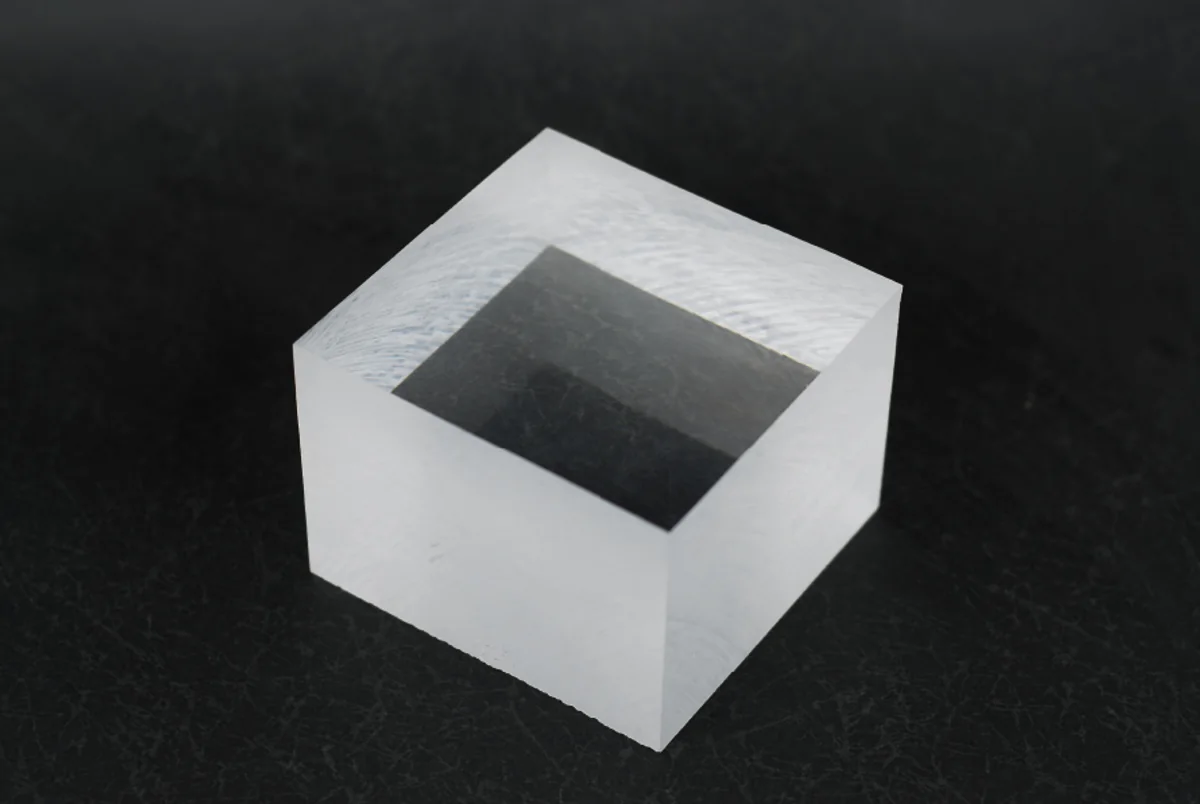 Heavy cast block. Above 25mm the 48 by 96 format is the only one Hsin Hwa casts, which is why thick acrylic parts are nested out of 4 by 8 sheet everywhere.
What HHC acrylic is tested against
A distributor telling you a sheet is compliant is worth less than a manufacturer publishing the report. Hsin Hwa puts eight documents on its own site, and it is a reasonable list to hold a caster to:
- Burning rate test report, which matters because acrylic is a combustible thermoplastic and someone will eventually ask
- Weather resistance test report, the one that decides whether a sign face survives ten Ontario winters
- SGS FDA test report, issued through SGS, for food contact applications such as display cases and bakery guards
- Material safety data sheet, needed by any shop with a health and safety binder
- RoHS test report, against the EU restriction of hazardous substances directive
- Light transmission curve, measured across 300 to 2300 nanometres at 3mm, 5mm and 10mm
- P95 transmittance rate report, covering the frosted surface grade
- UL Yellow Card, the UL Solutions plastics recognition record that specifiers ask for by name
The light transmission curve is the one worth actually reading. It shows clear Beauty Glass holding roughly 90 percent transmission flat across the whole visible band, then falling off a cliff below about 350 nanometres. That cliff is the useful part: the sheet passes the light you want and stops most of the ultraviolet you do not, which is why cast acrylic is the default for display cases and why the 10mm curve cuts UV harder than the 3mm.
Reading the curve at the other end is instructive too. All three gauges hold their plateau across the visible range and only begin separating past roughly 1100 nanometres, deep into the near infrared, where the thicker sheet absorbs progressively more. For anything a human eye will judge, the gauge you choose is a structural decision rather than an optical one.
The P95 report connects to a product we sell separately. If you are specifying frosted panels, the frosted acrylic sheet and P95 privacy panel guide covers what that surface grade does and, more usefully, why the gap behind the panel matters more than the sheet.
Need the actual test report, not a summary?
Ask and we will request the current document from the manufacturer and send it through unedited. That is a normal request from a specifier and it costs you nothing.
Cell cast, and why we keep saying it
 Cell casting is a slow batch process. Each sheet cures in its own glass cell rather than running off a die, which is where the optical quality comes from.
Cell casting means each sheet polymerises in its own glass cell rather than being pushed through a die. Röhm, which invented PMMA and still owns the PLEXIGLAS and ACRYLITE trademarks, describes the same split between cast and extruded product. It is slower and it costs more per sheet. What you get back shows up in four places a fabricator can feel:
- A cleaner laser cut. The edge comes off the machine flame polished and needs no secondary finishing
- A high contrast engrave. The laser reveals a bright frosted white under the pigment, which is why black cast acrylic became the standard for plaques and nameplates
- Better thermoforming. Cast holds its shape through a heat form where extruded tends to remember the die, and our laser cutting and engraving service runs on the same cast stock
- A higher heat deflection temperature, roughly 95°C against about 80°C for extruded PMMA
None of that makes cast the right answer every time. For high volume flat cutting where the edge gets covered anyway, extruded is a rational choice and costs less, which is why we stock both and tell customers which one their job actually needs. The complete guide to buying acrylic sheets in Canada works through that decision with current pricing on both.
Buying HHC acrylic in Canada
The 4 by 8 foot sheet is the unit of trade here, and it is the format Hsin Hwa supports most completely. We keep HHC cast acrylic at our North York warehouse in clear, black, white and the coloured range, and we cut it three ways on site: laser for detail and engraving, CNC router for heavier gauges and internal radii, panel saw for straight rectangular cuts.
A few things worth knowing before you order:
- Order by code, not by colour name. "Royal blue" means nothing across two suppliers. 2051 means one thing
- Masking stays on through fabrication. Cast acrylic scratches, and the film is there for the whole trip, not just the shipping
- Measure the gauge before you cut a slot. The published tolerance is real, and it is wider than most people assume
- Ask for thick sheet by the 48 by 96 format, since above 25mm nothing else exists to cut from
- Get the test report if a specifier is involved. We can pull any of the eight documents through from the manufacturer
For sizes and gauge selection, the acrylic sheet sizes and thickness guide lays out what each gauge is used for with real per sheet pricing. If your part is not a rectangle, our cut to size service prices laser, CNC and saw against each other live so you can see which process is cheapest for your geometry before you commit.



Where to buy HHC acrylic in Canada
From the distributor Hsin Hwa appointed for this market. The certificate and the sole agent agreement are both on our about us page, and the manufacturer's own site is at hsinhwa.com if you want to read the source rather than our summary of it. Their site runs on plain HTTP rather than HTTPS, so your browser may flag it. That is a hosting oversight on a small manufacturer's brochure site, not a reason to doubt the company.
We stock the range in North York and ship across Canada. The buying guides category collects everything we have written on sourcing sheet in this market, and when you are ready to price a run, send the schedule through our quote request or contact our team and we will work through codes, gauges and cutting with you.
Prefer to talk it through? Call us at +1 (416) 857-7555 for real answers from the warehouse floor.
TORONTO WAREHOUSE Unit 29, 601 Magnetic Drive, North York, ON, M3J 3J2
Phone: +1 (416) 857-7555 Office: +1 (416) 726-2428 Email: info@fidarsystem.com Quotes: Request a quote or contact us
Frequently Asked Questions
Written by
B.Sc. Materials Engineering · 12 yrs industry experience
Sarah brings over 12 years of hands-on experience in Canada's plastics and composites industry. She specializes in material selection, industrial-grade specifications, and supply chain optimization for manufacturers, fabricators, and distributors across the country.
Reader Reviews
Loading reviews…