


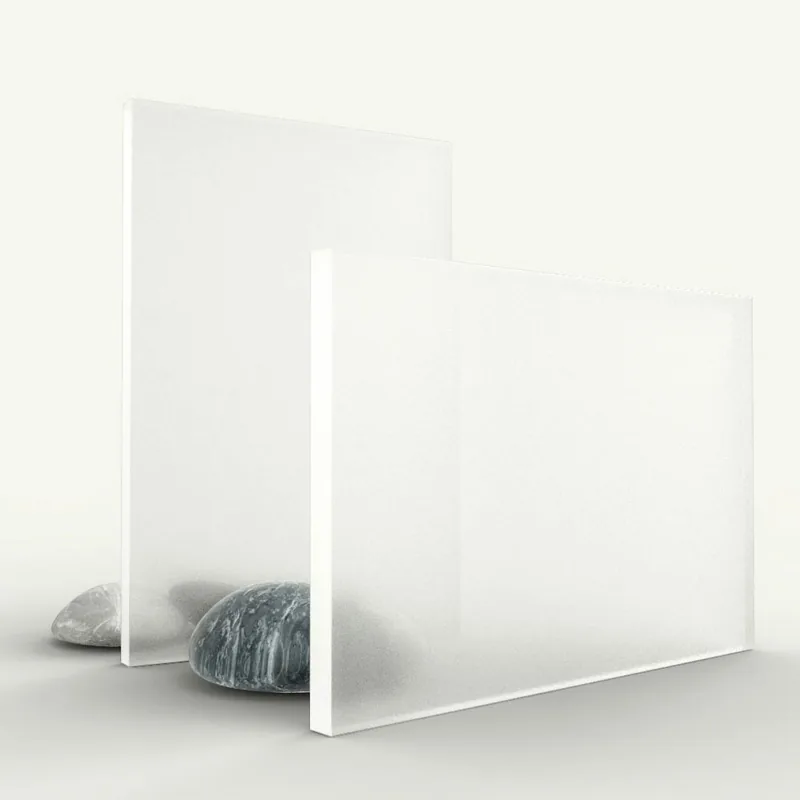
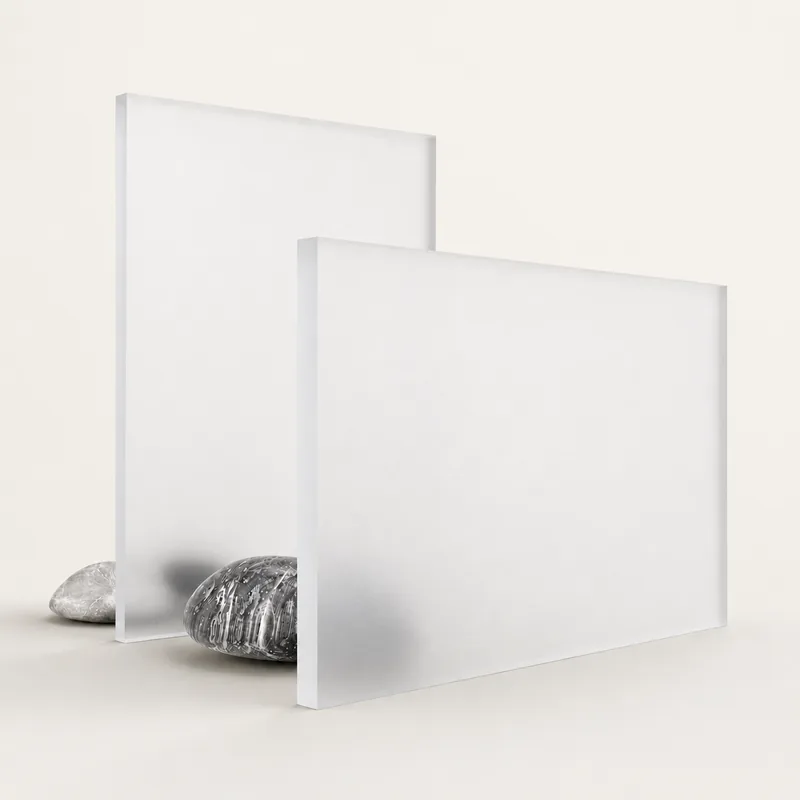
A frosted acrylic sheet is sold on one number and specified on three others. The number on the listing is light transmission, ours reads about 70 percent, and it tells you almost nothing about whether anyone will be able to see through the panel you are about to install. The three that decide the job are which face carries the frost, how far behind the panel the thing you are hiding actually sits, and what gauge stops a large panel bowing in its frame.
This guide is organised around the second of those, because it is the one nobody publishes and the one that gets fit-outs wrong. We stock P95 frosted acrylic in four gauges at our North York warehouse and cut it to size before it ships, so the numbers below are our own list prices rather than a range copied from somewhere else. Most of the people we quote it for are fit-out contractors and partition installers buying by the job, so the pricing at the end is worked per panel rather than per sheet.
What a frosted acrylic sheet is, and what P95 actually means
| Specification | P95 frosted acrylic, as stocked at FIDAR |
|---|---|
| Material | Cast PMMA |
| Colour code | P95-000M |
| Surface | Smooth gloss one face, velvety matte frost on the other |
| Light transmission | About 70 percent, diffused |
| Sheet size | 4 x 8 ft, 32 sq ft per sheet |
| Gauges stocked | 2.8mm, 4.3mm, 5.5mm, 9mm |
| Density | 1.19 g/cm3 |
| Heat deflection | 95 C |
| Cut to size | Laser, CNC router and saw, all eligible |
| Buy it | P95 frosted acrylic sheets |
P95 is a pattern designation. It describes a surface, not a colour and not a density of milkiness, and the P stands for pattern rather than percent. The ACRYLITE Satinice range, sold under the PLEXIGLAS name in Europe and ACRYLITE in the Americas on trademarks owned by Röhm, groups P95 and DP9 as its velvet texture grades, one sided and two sided respectively. That is the whole of the designation: a fine matte texture on one face. The sheet we stock is cast in Taiwan, and our manufacturer publishes its own P95 transmittance report alongside the rest of its test documents.
It matters because the alternative construction behaves completely differently. A bead diffused sheet carries light scattering particles distributed through the body of the material, so the diffusion is a property of the volume. A surface frosted sheet like P95 does its scattering in the top few microns of one face, and the other 2.8 or 9 millimetres underneath are ordinary clear cast acrylic. Everything below follows from that one distinction.
Transmission is the number you are given, haze is the number that hides people
Two sheets can both be honestly described as transmitting 70 percent of the light that hits them and look nothing alike. Transmission counts how much light gets through. It says nothing about where that light goes once it is through, and scattering is the entire mechanism by which a panel obscures anything.
The measurement that captures the second half is haze: the fraction of transmitted light scattered by more than 2.5 degrees off the incoming direction. Both are measured together under ASTM D1003, which is the standard test method for haze and luminous transmittance of transparent plastics, on an instrument like the haze meters BYK builds for exactly this. A supplier quoting transmission alone has given you half the data sheet.
Where the difference shows up hardest is thickness. The Satinice technical information sheet prints transmission for a surface textured colourless grade and a bead diffused colourless grade across the same four thicknesses:
| Thickness | Texture at the surface (0M001 SC) | Diffusing beads through the sheet (0D010 DF) |
|---|---|---|
| 3mm | 92% | 86% |
| 4.5mm | 92% | 82% |
| 6mm | 92% | 78% |
| 9mm | 92% | 68% |
The surface textured grade is flat across the range. The bead diffused grade loses eighteen points over the same span, because doubling the thickness doubles the number of scattering particles a ray has to pass. Those are two different Satinice products rather than a measurement of the sheet we stock, and a deeper velvet frost will read lower than a light crystal texture, so treat the levels as illustrative and the shape as the lesson.
The practical conclusion is worth stating plainly, because it inverts what most buyers assume. On a frosted acrylic sheet, gauge is a structural decision, not an optical one. Going from 2.8mm to 9mm buys you stiffness and flatness. It does not meaningfully buy you privacy.
Privacy is a function of the gap, not the sheet
Here is the thing that actually decides whether a panel works.
A frosted face scatters each transmitted ray into a cone. A point on the panel therefore gathers light not from a single point behind it but from a disc, and that disc grows in direct proportion to how far back the subject sits. Push something against the glass and the disc collapses to nothing, so it stays sharp. Stand a metre away and the disc is wider than your head, so your head stops existing as a shape.
Same subject, same panel, moved back. Each card shows 700 mm of width at a modelled scatter half-angle of 15 degrees.
Geometric model, not a measurement: blur diameter = 2 x separation x tan(15 degrees), rendered as a Gaussian approximation at sigma = diameter / 4. The 15 degree scatter half-angle is an assumption, chosen because it sits mid-range for a matte-textured surface. A shallower or steeper scatter slides the whole row along the distance axis without changing its shape, which is the point. Test a sample at your real setback before you commit a panel.
Read that row and the design rules fall out of it. Anything you want to stay legible has to touch the panel. Anything you want gone needs to be a few hundred millimetres back. The panel does not have a privacy rating, the installation does.
This is also why the same sheet can be a total success in a washroom and a total failure on a shower screen. In a washroom the person is a metre behind the screen. In a shower they are pressed against it.
Five distances in one office fit-out
Walk one floorplate from the ceiling down and you meet the same sheet at five different setbacks.
Touching the panel: cabinet fronts, bonded graphics, shower screens
At zero separation there is no obscuring at all. Frosting here is a finish decision, and a good one: the matte face hides fingerprints, kills reflections and takes ink and paint well, which is why every sign shop that prints direct to substrate keeps a matte grade on the rack for reverse printed cabinet inserts and applied graphics. Use 2.8mm in a captured frame. Do not sell it to anyone as privacy, because at this distance it does not deliver any.
20 to 50mm behind: light boxes and backlit panels
This is the LED setback, and it is the one case where the diffusing job is more important than the privacy job. Frosted acrylic scatters point sources into an even wash so the individual diodes stop reading as dots. If hot spots still show, the fix is almost always more setback rather than a heavier sheet, since gauge does very little here. Our guide to acrylic sheets and lighting works through LED pitch and diffuser selection in more depth.
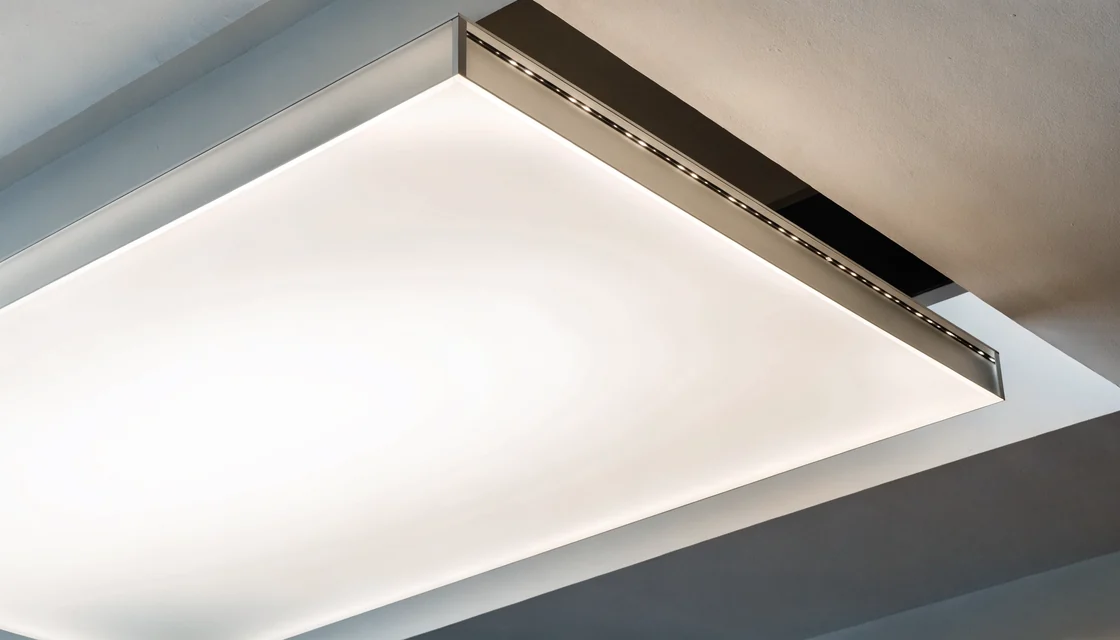 Even output with no visible dots is a setback problem before it is a material problem. The LEDs sit well back from the panel face rather than against it.
100 to 300mm behind: desk screens, counter returns, reception fronts
The most common commercial use, and the most misunderstood. At 150mm the model puts the spread at 80mm, so a laptop lid still reads as a laptop and a monitor as a monitor, while anything written on either has already gone. Push back to 300mm and the spread is wider than a head, so the person becomes a shape. That is usually exactly what a client wants from a desk screen: lose the face, keep the light. Specify 4.3mm for a screen up to about 1200mm wide with a clamp along the bottom edge.
 The distance rule visible in one photograph: the laptop close to the panel holds its edges, the people further back do not.
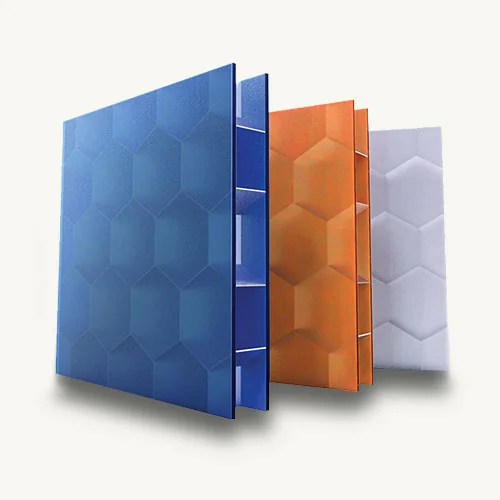
If the brief is a finished desk screen rather than cut sheet, Bencore's Split desk divider is a honeycomb panel on clamp brackets with a sound absorbing version, and its Stretch partition wall hangs the same panels on steel cables with no profiles at all. FIDAR quotes both as Bencore's Canadian dealer.
600mm and beyond: meeting rooms, washrooms, full height infill
Past about half a metre the panel is doing everything it is capable of and more distance changes little. This is where frosted acrylic genuinely substitutes for etched glass at a fraction of the weight. Move to 5.5mm for unframed or single edge fixed panels, and to 9mm where a screen stands free or spans more than about 1800mm without intermediate support. Flatness, not opacity, is what you are buying.
Not sure which gauge your panel schedule needs?
Send us the panel sizes, the fixing method and the setback, and we will tell you which of the four stocked gauges holds flat and what the run costs cut to size.
Get a free quoteWhat the frosting costs, gauge by gauge
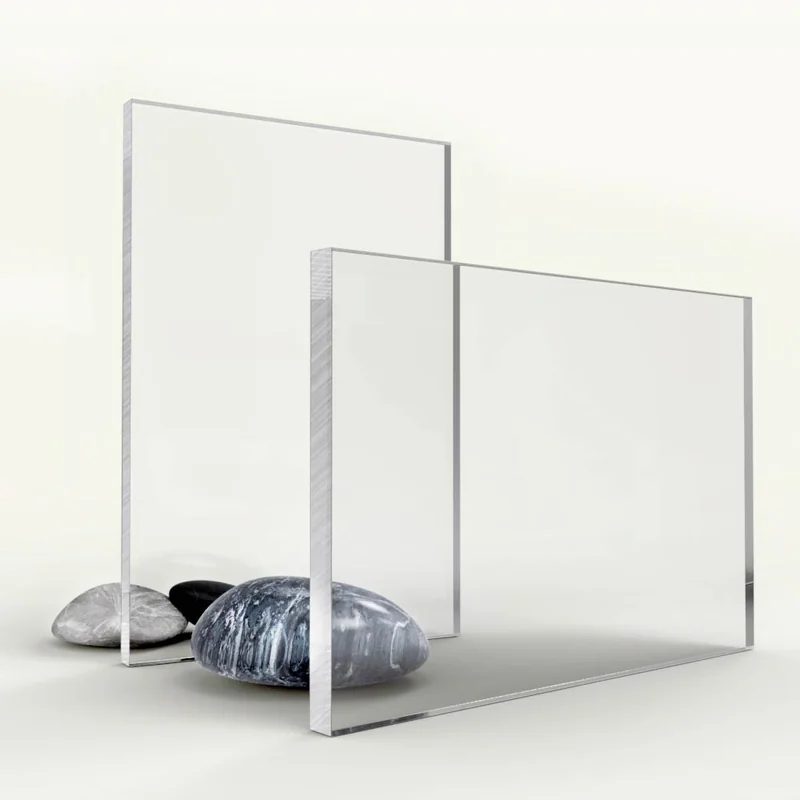
Clear cast acrylic and P95 come off the same 4 by 8 ft format in the same four gauges, which makes the frosting premium easy to isolate.
Per 4 x 8 ft sheet (32 sq ft)
Both prices read from our live product catalogue at page render, so they cannot drift from the sheet prices on the shop pages. Cheapest in-stock 4 x 8 variant at each gauge, CAD, before tax and delivery.
The premium does not hold steady, it collapses. Frosting adds 27.2 percent at 2.8mm, 21.2 percent at 4.3mm, 14.9 percent at 5.5mm and only 4.8 percent at 9mm. Put another way, the frost costs $21.80 on a thin sheet and $11.90 on the thickest one, so the heavier the gauge, the smaller the share of the price you pay for the finish.
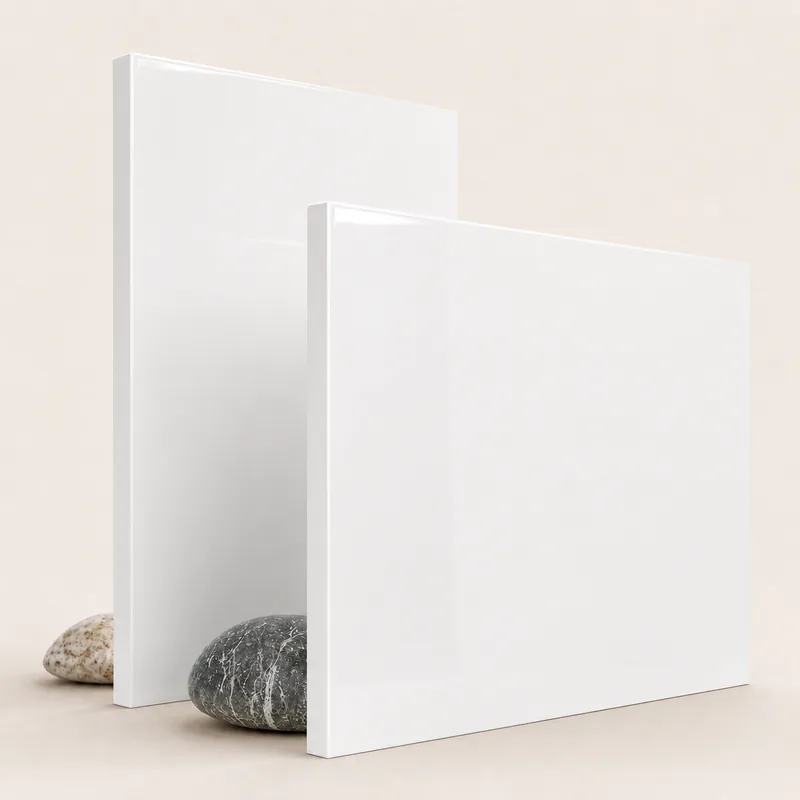
At 9mm the finish comes close to free. P95 at that gauge is $261.57 CAD, just $11.90 over clear cast at $249.67 and exactly the price of our opaque white cast acrylic at $261.57 in the same size, so on a thick panel the choice between frosted and opaque comes down to looks, not budget.
| Gauge | Sheet, 4 x 8 ft | Per sq ft | Weight per sheet | What it is for |
|---|---|---|---|---|
| 2.8mm, about 1/8 in | $102.07 | $3.19 | 9.9 kg | Cabinet inserts, light box faces, framed overlays |
| 4.3mm, about 3/16 in | $155.97 | $4.87 | 15.2 kg | Desk screens, framed partition infill |
| 5.5mm, about 1/4 in | $184.57 | $5.77 | 19.5 kg | Larger panels, vision panels, single edge fixings |
| 9mm, about 3/8 in | $261.57 | $8.17 | 31.8 kg | Free standing screens, wide unsupported spans |
Weights are computed from the 1.19 g/cm3 density on a true 48 by 96 inch sheet, the same basis used in our acrylic sheet sizes and thickness guide. All four gauges are in stock.
Pricing a full floor of partition panels?
Send the panel schedule through and we will quote the sheets, the cutting and the freight in one number instead of three.
Frosted acrylic sheet against frosted polycarbonate
We stock a frosted polycarbonate as well, and the choice between them is not the one most people expect. It is not a straight impact versus price trade, because the price relationship flips with gauge.
| P95 frosted acrylic | Single sided frosted polycarbonate | |
|---|---|---|
| Thinnest stocked | 2.8mm at $102.07 | 3mm at $98.35 |
| Around 1/4 inch | 5.5mm at $184.57 | 6mm at $287.55 |
| Gauges stocked | Four, 2.8mm to 9mm | Two, 3mm and 6mm |
| Cut to size online | Yes, laser, CNC and saw | No, full sheets only |
| Edge finish | Polishes optically clear | Sand and deburr, no flame polishing |
| Impact resistance | Standard cast acrylic | High |
| Frost construction | Velvet texture, one face | Co-extruded matte, one face |
At the thin end frosted polycarbonate is actually the cheaper sheet, by $3.72. At around a quarter inch it costs $102.98 more, which is 55.8 percent, and that is a lot to pay for impact resistance a boardroom screen will never be asked for. Spend it where a panel is genuinely at risk of being hit, in a school corridor, a gym or a machine guard, and take the acrylic everywhere else. Our acrylic versus polycarbonate comparison covers the wider material trade in detail.
One practical point that decides more jobs than the price does: the frosted polycarbonate is stocked as full sheets and quoted separately for any cutting, while P95 goes straight through our cut to size configurator. If the schedule is thirty panels at four sizes, that difference is the whole project.
Cutting, edges and handling
P95 machines like any other cast acrylic, with one habit that is specific to it.
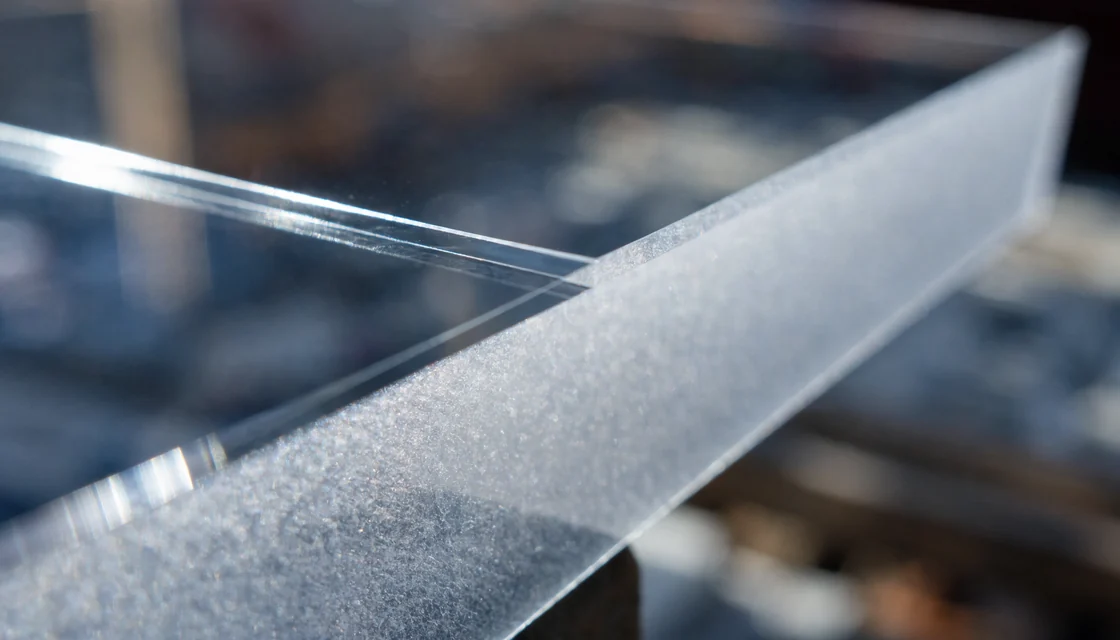 One gloss face, one matte face, and an edge that polishes optically clear. The two surfaces are visibly different where they meet.
Keep the masking on the matte face until the panel is installed. A frosted surface shows a scratch far more readily than a gloss one, and there is no polishing it out afterwards without leaving a shiny patch. Mark your cut lines and your face orientation on the film.
Decide which face goes where before you cut. For a privacy panel the matte face goes toward the side you want obscured. For a diffuser it goes toward the LEDs. Getting it backwards is not a disaster, but it costs you performance you paid for.
Run a test cut on an offcut. The frosted face can take a laser edge slightly differently from the smooth one, which is worth knowing before it happens on a finished panel rather than after. Any fabricator who already cuts clear cast will find nothing else new here.
The edge polishes clear. A flame polished or buffed edge on P95 comes out optically clear against the matte face, which reads as a deliberate detail on an exposed edge and is one of the reasons the material looks better than film applied frosting in an unframed panel.
One thing to raise with the design team, not with us. Acrylic is a combustible thermoplastic. The manufacturer says so plainly in the Satinice fire precautions, and it is why partitions, ceiling elements and anything in a corridor or exit route can attract a flame spread requirement that a decorative panel in an open office never will. We supply the sheet and we can tell you what it is, but we are not code consultants: for a rated location, have the requirement checked against the National Building Code of Canada and the provincial code that adopts it before the panel is written into the drawings. It is a much cheaper conversation at design stage than at inspection.
We cut all four gauges here. Rectangles, radiused corners, cutouts and fixing holes go through the cut to size service with live per piece pricing, and shaped or engraved panels through laser cutting and engraving. For panels that will be handled on site, ask for a small radius on the exposed corners rather than a square one.
Ordering frosted acrylic sheets in Canada
The thing that surprises most first time buyers is that panel size drives cost far harder than gauge does, because a panel either nests into the sheet or it does not.
| Panel | Size | Gauge | Per 4 x 8 sheet | Sheet used | Material per panel |
|---|---|---|---|---|---|
| Cabinet door insert | 400 x 700mm | 2.8mm | 9 panels | 84.8% | $11.34 |
| LED light box face | 600 x 600mm | 2.8mm | 8 panels | 96.9% | $12.76 |
| Desk mounted screen | 1200 x 400mm | 4.3mm | 6 panels | 96.9% | $26.00 |
| Meeting room vision panel | 600 x 1800mm | 5.5mm | 2 panels | 72.7% | $92.29 |
| Full height infill | 900 x 2100mm | 5.5mm | 1 panel | 63.6% | $184.57 |
Every row is computed from the real sheet price against a true 48" x 96" sheet, with pieces nested flat and the kerf held in the gap between them. The material figure is the sheet share only, before cutting.
Look at the last two rows. A 900 by 2100mm infill panel consumes an entire sheet and throws away more than a third of it, while a 1200 by 400mm desk screen leaves barely 3 percent on the floor. For example, a contractor who trims a full height module from 2100mm to 2000mm still gets one panel per sheet and saves nothing, while dropping a vision panel from 1800mm to 1200mm takes it from two per sheet to four and halves the material in it. Moving a panel module by 100mm at design stage is frequently worth more than any discount you could negotiate on the sheet.
To quote a run properly we need four things, and a schedule that carries them comes back priced the same day:
- Panel sizes in millimetres, finished, with a note on which dimension is the width
- The gauge, or the setback and fixing method so we can work the gauge out
- Corner radius, cutouts and hole positions, or a DXF if the fabricator has one
- The quantity per size, since the volume tiers land on identical parts
Three more things worth settling before an order goes in.
Volume pricing. Cut piece pricing steps down at 50, 500 and 1000 pieces of the same part, at 10, 15 and 20 percent respectively. Those tiers are on identical parts, not on mixed sizes, which is another reason to standardise panel modules across a fit-out. For how the trade pricing works across a larger order, our Toronto wholesale buyer's guide sets out the tiers, minimums and freight terms in full.
Stock and format. All four gauges are held on 4 x 8 ft sheets at North York. There is no 3 x 6 or 4 x 6 format in P95, so a small panel is cut from a full sheet rather than a smaller one.
Getting it there. Online checkout prices every Canadian address: our own fleet within 50km of the warehouse, live carrier rates anywhere else, with crating and edge protection included in the figure. Pickup is free from the North York door. For oversized or unusual loads we still quote the panels and the freight together by hand, which is the only honest way to price those. If you are comparing suppliers, our guide to finding plexiglass near you in Canada covers what to ask before ordering.
Where to buy frosted acrylic sheet in Canada
From a supplier who stocks all four gauges, cuts them before they ship, and will tell you honestly when the panel you have drawn will not be as private as you are expecting. We keep P95 frosted acrylic at our North York warehouse and cut it to your panel schedule here.
If the specification is still open, the complete guide to buying acrylic sheets in Canada is the right place to start, the acrylic sheets category collects everything we have written on grades and applications, and top uses for plexiglass sheets covers the wider application set. When you are ready to price a run, send the schedule through our quote request or contact our team and we will work through the gauges and setbacks with you.
Prefer to talk it through? Call us at +1 (416) 857-7555 for real answers from the warehouse floor.
TORONTO WAREHOUSE Unit 29, 601 Magnetic Drive, North York, ON, M3J 3J2
Phone: +1 (416) 857-7555 Office: +1 (416) 726-2428 Quotes: Request a quote or contact us
Frequently Asked Questions
Written by
M.Arch, RAIC Associate · 9 yrs architectural specification
David is an RAIC Associate with 9 years of experience specifying architectural plastics for commercial and residential projects across Canada. His work bridges material science and aesthetic application, helping designers and contractors choose the right panel systems for every build.
Reader Reviews
Loading reviews…