

A roll of printable magnetic sheet is 100 square feet of decisions. Before it earns anything, a sign shop has to pick the gauge, the face, the laminate and the layout, and each of those can quietly cost a job. The wrong gauge peels off a van at highway speed. The wrong laminator turns a roll into very expensive white vinyl. A careless layout can leave a quarter of the roll in the bin.
This guide follows the roll the way it moves through your shop: buy, print, laminate, cut, fit. Each stage starts with the rule, then the reasons. The prices and yields are not typed in. They are read live from our catalogue every time the page loads, so they match what the checkout charges today.
The roll on the bench
Our flexible magnetic sheet comes as one format: 24 inches wide by 50 feet long, which is exactly 100 square feet. It is a rubber based magnet with a white vinyl face bonded on top, and that face is the only side you print. You choose two things, the gauge and the face, which makes four rolls in all.
| Gauge | Face | Per roll | Per sq ft | Per linear ft | Stock |
|---|---|---|---|---|---|
| 20 mil0.020" · MGN-R-1002 | Gloss White | $186.55 | $1.87 | $3.73 | In stock |
| 20 mil0.020" · MGN-R-1001 | Matte White | $153.40 | $1.53 | $3.07 | In stock |
| 30 mil0.030" · MGN-R-1004 | Gloss White | $186.55 | $1.87 | $3.73 | In stock |
| 30 mil0.030" · MGN-R-1003 | Matte White | $153.40 | $1.53 | $3.07 | In stock |
Live from our catalogue, in CAD before HST and delivery. Order the roll
Because every roll is 100 square feet, the square foot price is just the roll price moved two places. A matte roll at $153.40 works out to $1.53 a square foot, and a gloss roll at $186.55 to $1.87. That is the number to build a quote on, since nobody sells a customer a roll.
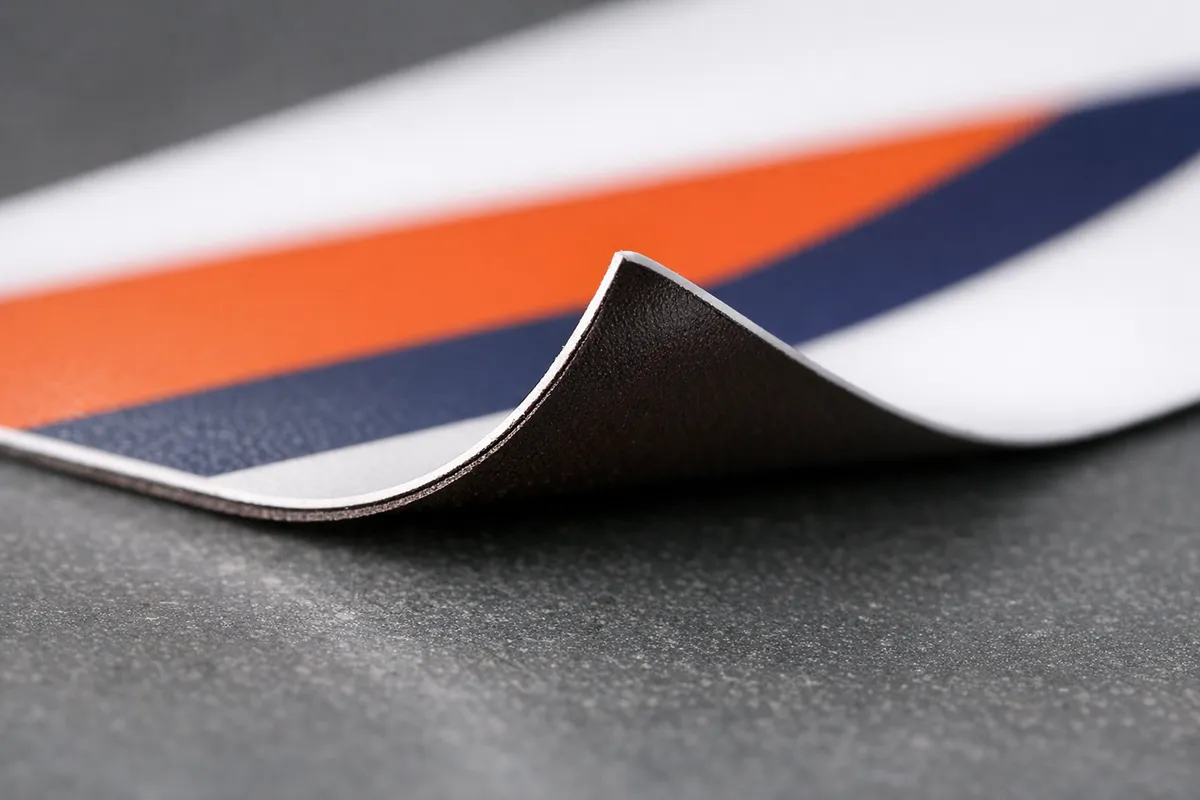 One bonded sheet: the white vinyl face takes the ink, the brown magnetic layer underneath does the holding. Print the face, never the back.
Buy: 20 mil or 30 mil
The rule: if it goes on a vehicle, buy 30 mil. Keep 20 mil for indoor and promotional work.
A mil is a thousandth of an inch, so 30 mil is 0.030 inches, about three quarters of a millimetre. That is the nominal thickness of a bank card under the ISO/IEC 7810 card standard, which is a handy way to explain it to a customer holding one.
20 mil magnetic sheet0.020" · 0.51 mm
30 mil magnetic sheet0.030" · 0.76 mm
Bank card (ISO/IEC 7810 ID-1)0.76 mm
Drawn at 60 times actual thickness, all three at the same scale. Card thickness is the ID-1 standard used for payment cards.
The extra third of a millimetre is more magnet, and more magnet means a stronger grip and a stiffer sheet. That is why the guidance from sign suppliers and the big magnet printers lines up: 30 mil for car, van and truck doors, and 20 mil for indoor work. Custom Ink's car magnet guide puts it plainly, a standard fridge magnet is about 20 mil and vehicle door magnets start at 30. Our own product guidance agrees, and adds menu panels and trade show graphics to the 20 mil list.
Thicker is not always better on a vehicle, though. The same guide warns that a stiff magnet bridges over the curve of a door instead of conforming to it, and the air gap at the edge is what lifts the sign at speed. Thirty mil is thick enough to hold and still thin enough to follow a normal door panel.
One more check belongs here, before you quote: is the panel steel? No gauge will hold on aluminum, fibreglass or plastic. Ford has built the F-150 body panels from aluminum since the 2015 model year, and Vistaprint notes that some newer vehicles carry less steel and that the filler used in body repairs blocks the hold. Put a small magnet on the exact spot before you take the order.
Print: matte face or gloss face
The rule: pick the face by the light the sign will sit in, not by the printer.
Both faces take solvent, UV and latex inks on a roll fed wide format printer, so the choice is about how the finished piece looks.
- Matte white cuts glare. It suits indoor signage, menu boards and direct printed work that people read up close under shop lights, and it is the usual base for graphics you will cold laminate.
- Gloss white is the high reflectivity face. It suits outdoor vehicle graphics, promotional magnets and display pieces.
If you laminate, the laminate film sets the final finish your customer sees, so a matte film over a gloss face reads as matte. Print on the white vinyl face only. The magnetic side is not a print surface.
Laminate: cold, never hot
The rule: pressure sensitive laminate, applied cold. If your laminator has heated rollers, switch them off and let them cool before the magnetic run.
This is the stage where a whole roll is easiest to ruin, and the reason is simple arithmetic. The magnetic layer is ferrite powder held in a binder, and Eclipse Magnetics, a UK magnet maker, says that binder softens from about 50 to 70 degrees Celsius, at which point the magnetic performance is lost. Heating past a magnet's rating does lasting damage: it does not come back when the sheet cools. Published limits run from about 50 to 80 degrees. Heat activated laminating films do not even start sealing until they are hotter than that.
Cold laminate, pressure sensitive18 to 25°C (64 to 77°F)
Applied by roller pressure at room temperature. No heat at all.
Flexible magnet, published limits50 to 80°C (122 to 176°F)
Eclipse Magnetics: binder softens from 50 to 70°C, and its standard sheet is rated to 60°C. The roll we stock is rated to about 80°C.
Heat activated laminating film, sealing temperature85 to 91°C (185 to 195°F)
A low melt wide format film seals from 185°F. SEAL PrintGuard runs at 185 to 195°F.
Hot roll laminator, top roller setting130°C (266°F)
One 65 inch wide format laminator, the Easymount EM-1650DH, runs its rollers up to 130°C.
Where Eclipse Magnetics says the binder starts to soften, 50°C. Treat anything to the right of this line as damage.
Sources: Eclipse Magnetics flexible magnetic materials and magnetic sheet pages; FIDAR magnetic roll specification; MyBinding product data for low melt 3 mil wide format film and SEAL PrintGuard 2 mil; Easymount EM-1650DH specification. Ratings vary by maker, so check the data sheet for the exact roll and film you use.
Read the chart left to right. Cold laminate sits far below the magnet's limit. The coolest heat activated film sits above even the most generous magnet rating, so there is no setting where the film bonds and the magnet survives. The same logic covers anything else hot: keep printed sheet off heaters, and remind customers that the big printers' care notes, Custom Ink's among them, say to take the sign off a vehicle parked in direct sun for long periods.
Cut: fifty feet, three door sizes
The rule: lay the job out on the roll before you print it. Most of the waste is decided at the layout, not at the knife.
A 24 inch roll suits door signs, because sizes like 12 by 24 and 12 by 18 inches either fill its width or split it evenly. The chart below unrolls the 50 feet into five 10 foot lengths and nests three typical door sign sizes the way they would actually be cut. Each pair of shaded pieces is one vehicle, since vans and trucks have two doors.
12 × 24 in
- Pieces per roll
- 50
- Vehicle pairs
- 25
- Roll used
- 100%
- 30 mil matte white, per piece
- $3.07
- 30 mil gloss white, per piece
- $3.73
12 × 18 in
- Pieces per roll
- 66
- Vehicle pairs
- 33
- Roll used
- 99%
- 30 mil matte white, per piece
- $2.32
- 30 mil gloss white, per piece
- $2.83
Last 6 in of the roll is offcut.
18 × 24 in
- Pieces per roll
- 33
- Vehicle pairs
- 16
- Roll used
- 99%
- 30 mil matte white, per piece
- $4.65
- 30 mil gloss white, per piece
- $5.65
Last 6 in of the roll is offcut.
Straight grid nesting on a 24 in by 50 ft roll, each size tried both waysround. Knife or plotter cut, so no kerf, and no trim margin held back. Shaded pairs are one vehicle each. Material cost is today's roll price divided by the piece count, before ink, laminate, cutting and labour.
The 12 by 24 inch sign uses every square inch: two across the roll, 25 rows down it, 50 signs. The 12 by 18 does almost as well with 66 signs and six inches spare at the end. The 18 by 24 is the one to watch. Turned the wrong way it fits once across with six inches of waste down the whole roll and gives 25 signs. Turned so the 24 inch side runs across, it gives 33. Same roll, same customer, eight more signs.
Two cutting habits pay for themselves:
- Round the corners. Fellers' notes on Magnum's 30 mil vehicle magnet say the corners are usually the first place a sign stops holding, and that rounding them helps. Vistaprint gives the same reason: rounded corners reduce wind lift at highway speed.
- Hold back the start of the roll. Keep the first few inches for squaring and a test print. The chart assumes no margin at all, so plan on a pair or two fewer than it shows.
Fit: the handout for your customer
The rule: a well made magnetic sign can still fail from how it is used. Send the care notes out with the job.
These are drawn from the care notes that magnet makers and the big online printers publish for vehicle magnets, with the source named in each point. They are worth printing on the back of your invoice.
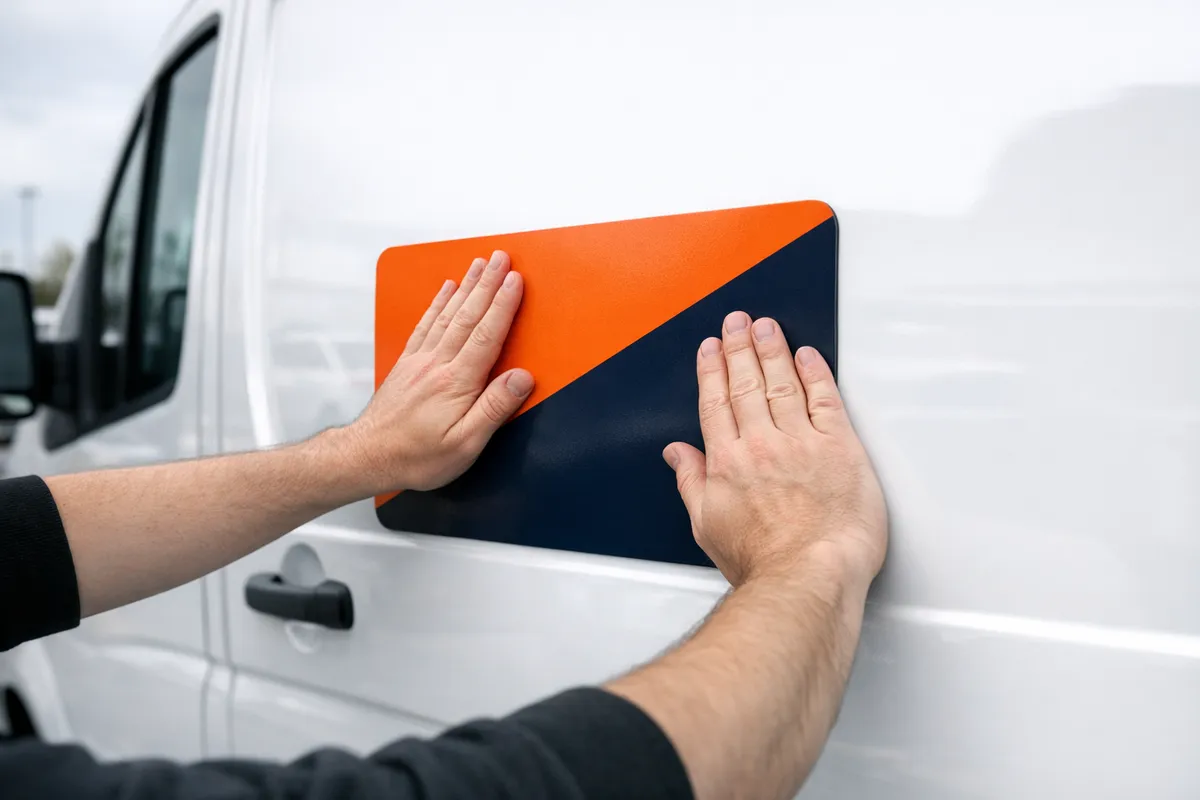 Rounded corners, a flat steel panel, and pressure from the centre outward so no air is trapped underneath.
- Steel, flat, clean and dry. Fit the sign to an area that is flat or only mildly curved, with steel under all of it. Clean and dry both the panel and the back of the magnet before it goes on.
- Not on fresh paint. Vistaprint's care terms give about 90 days for new paint, 60 for clear coat and 2 for wax before a magnet goes on.
- Off often, and before every car wash. The guidance varies: Magnum's note on its 30 mil vehicle magnet says remove and clean it daily, Vistaprint says every two or three days with a weekly clean, and to take it off before any car wash.
- Never on the roof or hood. Vistaprint rules out horizontal panels such as the roof, and warns against direct or constant sunlight.
- Lift from the side, never a corner, and never slide it. Vistaprint says to lift a sign from its sides rather than a corner, and that sliding it into place can stretch it and scratch the paint.
What we sell, and what stays your work
We supply the roll. You do the printing, the laminating, the cutting and the fitting, which is where the margin on a magnetic sign lives. We do not print, we do not sell finished or precut car magnets, and we do not stock adhesive backed magnetic sheet, so if a customer asks for any of those, the job is yours to quote.
All four rolls are held at our warehouse at Unit 29, 601 Magnetic Drive in North York. Yes, Magnetic Drive. You can order a roll online and collect it, and a shop running magnetic work every week can send us a standing order to price.
Magnetic sheet is the removable member of the sign family. When the customer wants something permanent, the plastic sign board material guide compares every rigid substrate we stock by the job it suits. For outdoor panels that stay up for years, the ACM panel guide for sign making covers routing, folding and finishes, and for indoor rigid signs the PVC foam board guide is the place to start. Everything we hold in the panel range, magnetic roll included, is listed under composite panels.
Running magnetic work every week? Call +1 (416) 857-7555 to check roll stock or price a standing order from our North York warehouse.
Frequently Asked Questions
Written by
B.Sc. Materials Engineering · 12 yrs industry experience
Sarah brings over 12 years of hands-on experience in Canada's plastics and composites industry. She specializes in material selection, industrial-grade specifications, and supply chain optimization for manufacturers, fabricators, and distributors across the country.
Reader Reviews
Loading reviews…