

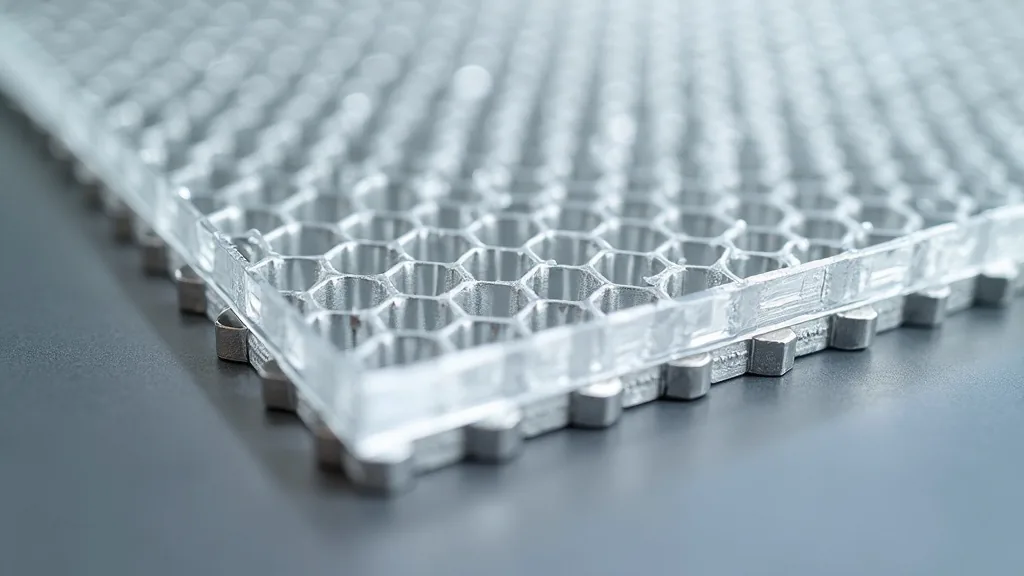
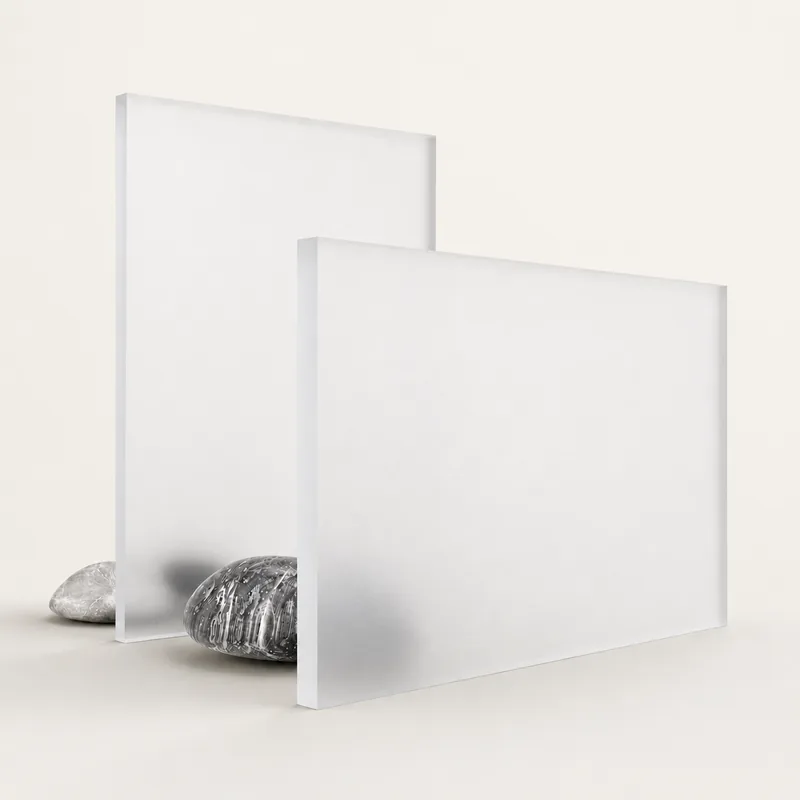
Honeycomb composite panels solve a problem solid sheet cannot. They hold a large architectural plane rigid without carrying the weight that normally comes with thickness. We stock the Italian HEXABEN Clear panel at our North York warehouse, a 19mm sheet in a 3.3 x 10 ft format, and it shows up in reception counters, backlit feature walls, and gallery partitions where a designer needs a span that is big, stiff, light, and translucent all at once. This guide works through what the panel is made of, the geometry that makes it stiff, what it costs against solid sheet, and how to detail it so the job goes in cleanly.
Panel data sheet: what we stock
| Specification | HEXABEN Clear, as stocked at FIDAR |
|---|---|
| Construction | Sandwich panel: clear acrylic face sheets bonded to a hexagonal aluminium honeycomb core |
| Total thickness | 19mm, close to 3/4 inch |
| Sheet size | 3.3 x 10 ft, about 33 sq ft per panel |
| Appearance | Clear to translucent, with the hexagonal cell pattern visible through the face |
| Sheet price | $1,930.00 CAD per panel |
| Stock status | In stock, new arrival, North York warehouse |
| Typical use | Backlit feature walls, counter fronts, partitions, gallery and display systems |
| Buy it | Honeycomb composite panels product page |
That is one SKU, deliberately. HEXABEN is a specialty architectural panel rather than a stock sheet line, so we carry the clear 19mm build and quote everything else against the project.
What a honeycomb composite panel actually is
Three parts, and only one of them does the work you would expect.
The faces. Two flat sheets of clear acrylic, bonded to the core. These carry the tension and compression when the panel bends, the same way the top and bottom flanges of a steel I beam do.
The core. Aluminium foil expanded into a grid of hexagons and set on edge between the faces. It carries very little bending load of its own. Its only structural job is to hold the two faces a fixed distance apart and transfer shear between them without collapsing.
The bond. The adhesive line between core and face. It is the quiet failure point of every sandwich panel, which is why fabrication technique matters more here than on solid sheet.
Bencore, the Italian manufacturer behind the HEXABEN line, describes it as an ultra-light composite panel with a honeycomb aluminium core bonded to external layers in acrylic, and calls it the lightest panel in their range. The core is not a decorative invention: it is the same construction aerospace structures have used for decades, where aluminium honeycomb is standard for exactly the stiffness-per-kilogram reason covered below. Bencore builds the line in two cell sizes, a 9mm cell on the Small version and a 25mm cell on Large, on a 1000 by 3015mm sheet, which is the metric original of the 3.3 by 10 ft format we list. The clear acrylic faced version is the one that reads as an architectural material rather than an industrial one, because you can see the geometry through the face.
Since October 2026 FIDAR has been Bencore's authorized dealer and distributor for Canada, so the whole range is quoted here, not only the stocked 19mm clear sheet: Hexaben Small, Large and Mirror in every finish code, the Starlight and Lightben families, and the Living doors, walls and office partitions, all on our Bencore pages.
That visible geometry is the reason most of our customers buy it. On the MARUN reception counters in our project portfolio, the panel was specified for the counter fronts precisely so the hexagons would show through concealed backlighting. The structure is the finish.
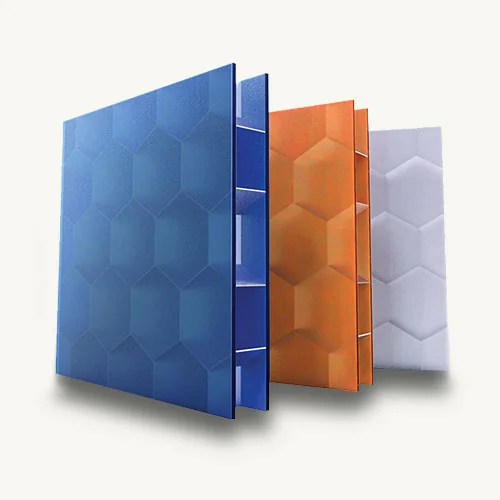
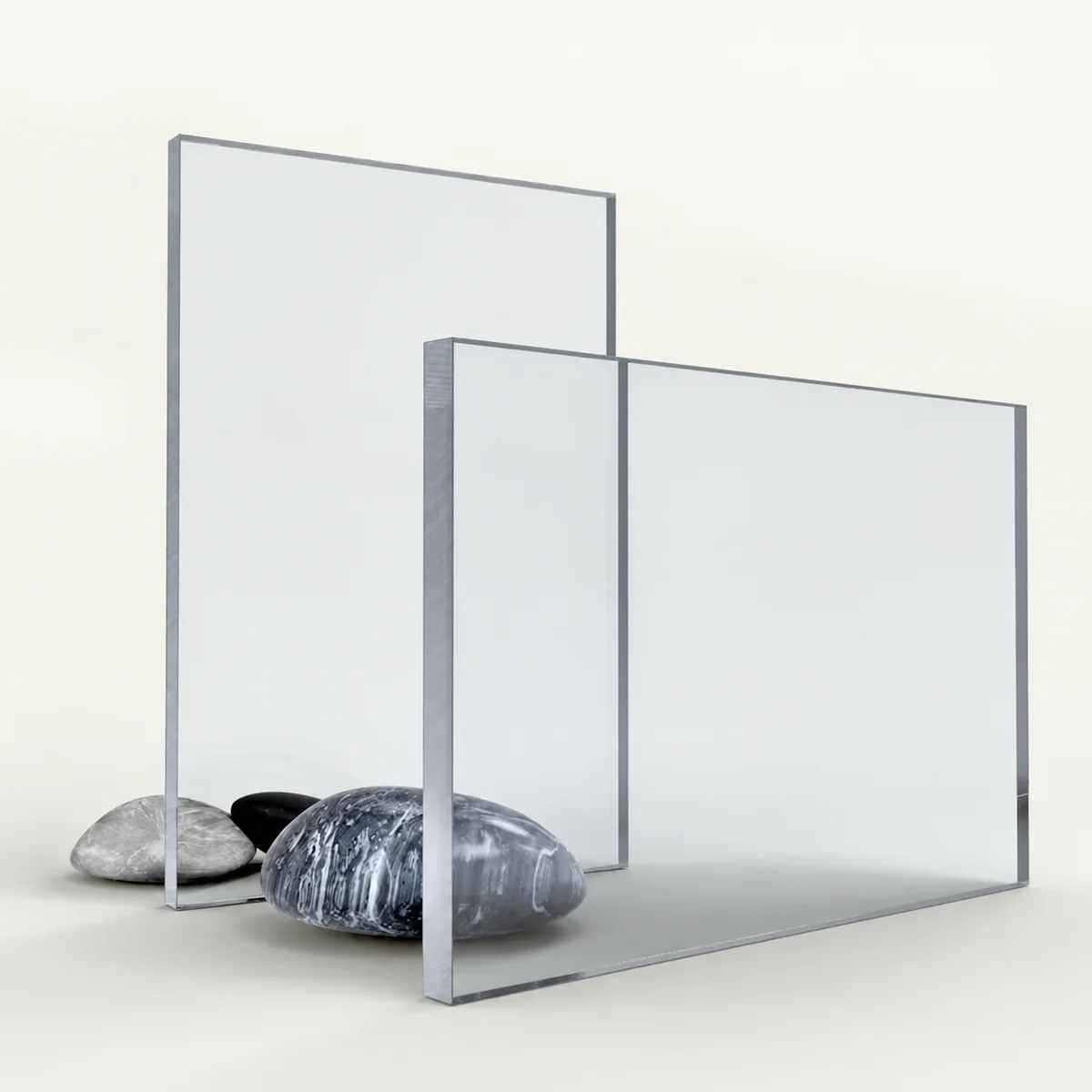
The geometry: why 19mm of mostly air beats 19mm of solid sheet
Here is the part worth understanding before you price anything, because it explains why the panel is worth a premium at all.
A panel's resistance to bending depends on how far its material sits from the middle. Not on how much material there is, but on where that material is. Move a face sheet away from the centre line and its contribution to stiffness climbs with the square of the distance. Double the separation and you get four times the effect from the same aluminium and acrylic.
That is the whole trick. A honeycomb core adds almost no mass, because it is aluminium foil and air, but it pushes the two faces apart. The faces do the work, and the core just holds them in position.
The chart below runs the numbers on a worked example: two 3mm cast acrylic faces held constant, an aluminium honeycomb core filling the gap, and total panel thickness climbing from 6mm to 21mm. Weight is on the left, bending stiffness relative to the 6mm solid case is on the right.
Read the two series against each other and the case makes itself. Going from 6mm to 19mm adds 9 percent to the panel weight and multiplies bending stiffness by about 21. Nothing you can do with solid sheet comes close to that trade. To get the same stiffness out of solid acrylic you would be specifying something around 17mm thick and carrying roughly three times the weight per square metre.
The caveat is real and worth stating plainly: those numbers are geometry, calculated the way any sandwich panel is analysed under ASTM C393 flexure testing, and they are not a substitute for a manufacturer's certified test data. Sandwich panels also fail in ways solid sheet does not, through core shear and face wrinkling rather than simple bending, and on short spans core shear governs. For a structural application, get the data sheet and put an engineer on it.
What honeycomb composite panels cost in Canada
Now the number that decides most projects. Honeycomb composite panels sit at the specialty end of the sheet market, so here is the HEXABEN panel against the solid materials we stock alongside it, at real July 2026 FIDAR pricing.
| Panel | Thickness | Sheet size | Sheet price CAD | Per sq ft | Weight |
|---|---|---|---|---|---|
| HEXABEN Clear honeycomb | 19mm | 3.3 x 10 ft | $1,930.00 | $58.48 | ~7.8 kg/m2 (calculated) |
| Cast clear acrylic | 18mm | 4 x 8 ft | $550.97 | $17.22 | 21.4 kg/m2 |
| Cast clear acrylic | 20mm | 4 x 8 ft | $614.97 | $19.22 | 23.8 kg/m2 |
| Clear polycarbonate | 9mm | 4 x 8 ft | $357.95 | $11.19 | 10.8 kg/m2 |
| ACM, white matte | 3mm | 4 x 8 ft | $63.18 | $1.97 | 3.56 kg/m2 (weighed) |
Solid sheet weights are calculated from published material densities. Two things jump out of that table.
The first is that honeycomb costs about three and a half times what solid cast acrylic costs per square foot. If your panel is small, flat, and does not need to be light, solid sheet wins on every count and you should buy cast clear acrylic instead. Our complete guide to buying acrylic sheets in Canada covers that side of the decision.
The second is what happens at full sheet size. A 3.3 by 10 ft honeycomb panel covers about 33 sq ft and works out near 24 kg, so one person carries it. An 18mm cast acrylic sheet covers 32 sq ft, three percent less area, and weighs about 64 kg. That is a two person lift, a wider door, and a heavier substructure behind the finish. On a tall counter front or a full height partition, the weight difference is not a convenience, it is what makes the detail buildable.
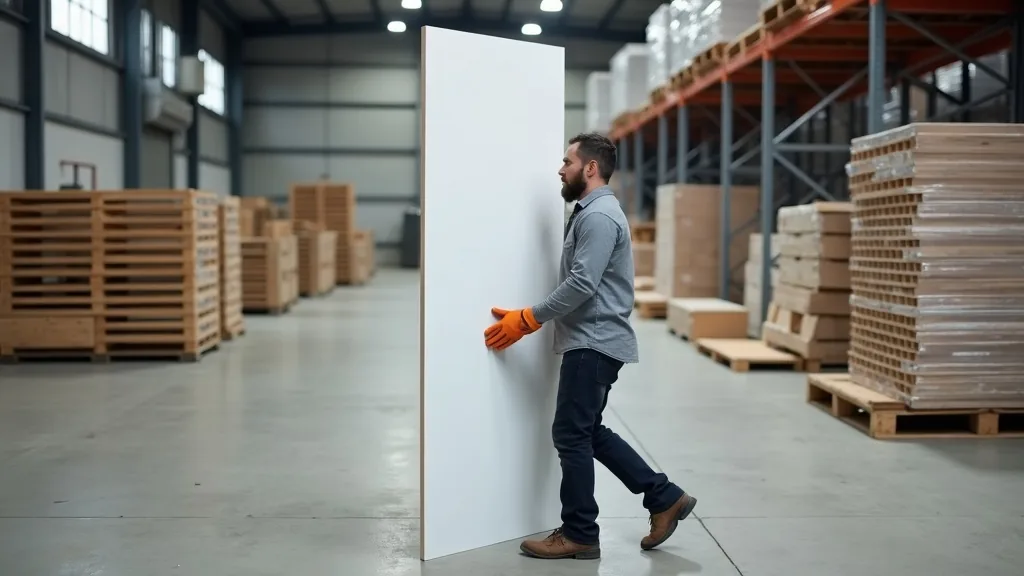 At full sheet size the weight difference stops being a convenience: one person moves a 3.3 by 10 ft honeycomb panel that would be a two person lift in solid acrylic.
Pricing a honeycomb panel into a project?
Send us the panel sizes, the edge condition, and your delivery window. We quote the panel, the cutting, and the freight together so the number in your budget is the number you pay.
Costing a real wall: 16 by 9 ft, panel by panel
A square foot price hides what a job actually costs, because you buy whole panels and then cut waste off them. Here is a feature wall of the kind we quote most weeks: 16 ft wide, 9 ft floor to ceiling, with the designer asking for no horizontal joints.
Stand HEXABEN panels upright and the 10 ft length swallows a 9 ft ceiling in one piece, so the wall has no horizontal seam anywhere. Across the width, 16 divided by 3.3 is 4.85, so you buy five panels and trim 6 inches off the last one. Run the same wall in 18mm cast acrylic and the 8 ft sheet cannot reach 9 ft, so you are into two rows and four horizontal joints across the feature.
| Line item | HEXABEN 19mm | 18mm cast clear acrylic |
|---|---|---|
| Panel size | 3.3 x 10 ft (33 sq ft) | 4 x 8 ft (32 sq ft) |
| Panels needed | 5 | 8 (4 wide, 2 high) |
| Material bought | 165 sq ft | 256 sq ft |
| Offcut waste | 21 sq ft (13%) | 112 sq ft (44%) |
| Horizontal seams | none | 4 |
| Material cost | $9,650.00 | $4,407.76 |
| Cost per sq ft of finished wall | $67.01 | $30.61 |
| Panel weight hung on the wall | about 120 kg | about 510 kg |
Two things in that table are worth sitting with. The first is that the honeycomb wall costs $67.01 per square foot of finished surface, not the $58.48 headline price, because 13 percent of what you buy ends up as offcut. Every sheet material behaves this way, but it bites hardest on honeycomb composite panels because a single wasted panel is $1,930 rather than $50, so the finished surface figure is the one that belongs in the budget. Quote the headline figure to a client and you are 15 percent short before anyone has cut anything.
The second is that acrylic is not really the cheaper option here so much as a different wall. It is 2.2 times less in material, but it arrives with four horizontal seams through a feature the designer specified as seamless, and it puts 510 kg on the substructure instead of 120 kg. If the seams and the dead load are both acceptable, buy the acrylic and spend the difference elsewhere. If either one is not, the honeycomb premium is the price of the detail, not a markup.
Freight sits on top of both, and we quote it per project rather than by a rule of thumb, because a 10 ft crated panel going to Calgary is a different number from the same crate going across the GTA. What matters at budget stage is that it is a real line rather than a rounding error, and that ordering the offcut allowance in the same shipment is far cheaper than a second freight run for one replacement panel.
Where the panel earns its price, and where it does not
Honeycomb composite panels are a specialist's choice rather than a default, and we would rather sell you the right material than the expensive one, so here is the honest split.
It earns its price when:
- The span is large and has to stay visually flat, such as a full height partition or a long counter front.
- Light has to pass through a structural element, which is the backlit feature wall case.
- Dead load on the supporting structure is constrained, as with suspended ceilings, canopies, and hung panels.
- The install crew is small, the access is tight, or the panel goes up a stair.
- The cell geometry is wanted as a visible design feature rather than tolerated as a byproduct.
It does not earn its price when:
- The panel is under about 4 ft in any direction, where solid sheet is stiff enough and far cheaper.
- Optical clarity matters, since you are always looking through a cell structure and never through clean glazing.
- The edges cannot be capped, because a raw honeycomb edge is not a finish.
- The application is exterior without a sealed edge detail confirmed with the manufacturer.
- The budget is per square foot on a large area, where ACM composite panels deliver a flat, light, rigid face for a fraction of the cost.
That last one deserves a sentence of its own. ACM and honeycomb both get called composite panels and they do genuinely different jobs. ACM is 3mm, opaque, and about $1.97 per square foot, which makes it the default for signage and cladding. Our ACM panel guide for Canada covers where it fits, the ACM fabrication guide for sign shops covers how to work it, and the ACM supplier and pricing guide has the full eight finish price list if you are costing the cheaper route. Honeycomb is 19mm, translucent, and structural. If you are choosing between them on price alone, you are choosing the wrong way round.
Detailing it: edges, fixings, and backlighting
Three details decide whether honeycomb composite panels read as considered or improvised once they are on the wall.
Cap every edge
A cut edge exposes open cells. Dust and insects get in, moisture gets in, and none of it comes back out. On a clear panel every bit of that is visible through the face. Cap the edge with an aluminium U channel, a PVC edge band, or a bonded clear acrylic strip, chosen to suit how the edge reads in the design. A capped edge also adds real stiffness along that run, which helps on a free standing panel.
Spread the fixing load
Do not clamp a fastener down onto a face sheet. The core under the washer crushes, the face dimples, and on a clear panel the dimple is permanently visible. Carry the panel in perimeter framing, aluminium extrusion, or timber battens wherever the design allows. Where a through fixing is unavoidable, use a wide backing washer or a bonded insert to spread the load into the face rather than into the core.
Test the backlighting before you commit
Backlighting is the application this panel is bought for, and it is also the one most often got wrong on the first try. Set LED strips 80 to 120mm behind the panel so the light has room to spread before it reaches the cells. Closer than that and you print hot spots straight through the hexagons. Build a sample panel with the actual strips, at the actual setback, and look at it before the millwork is built. Our article on acrylic sheets and lighting covers the diffusion side in more depth, and where the panel is a pure light diffuser without a structural role, LED diffused acrylic does the job for a great deal less.
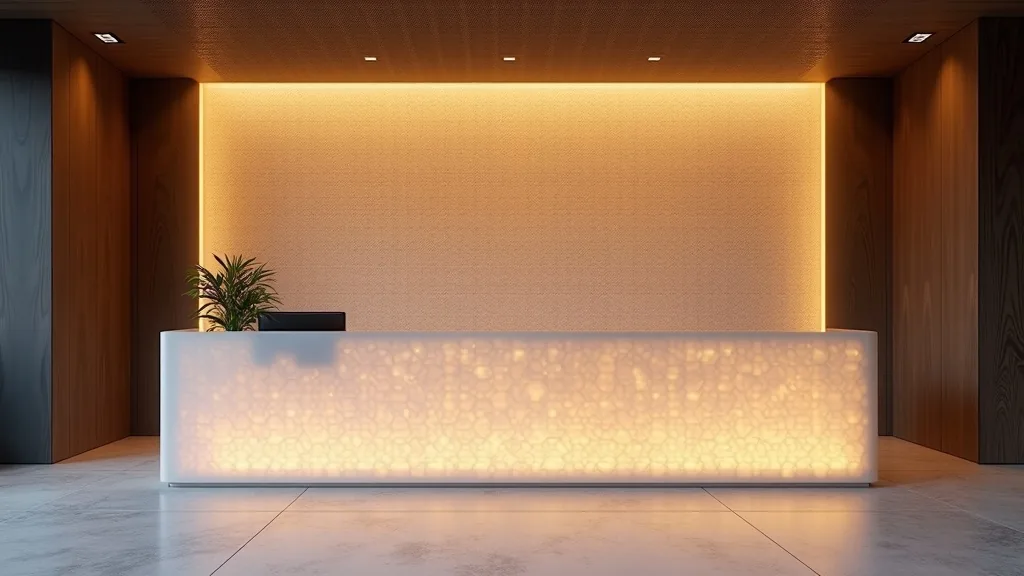 Backlit counter front: the cell geometry reads as a soft repeating pattern, which is exactly the effect the clear panel is specified for.
Protect it through construction
One more habit worth building, because it is the mistake that costs a whole panel. Honeycomb composite panels arrive with protective film on both faces, and that film should stay on until the trade after you has finished. A clear panel cannot be cleaned internally: drywall dust, silicone overspray, or a paint fleck that reaches an open cell through an uncapped edge is there permanently, and it sits in plain view behind the face. Cap the edges early, leave the film on late, and sequence the panel in as one of the last items on the floor.
Cutting and machining it without delaminating a panel
Fabricating honeycomb composite panels is not the same job as cutting solid sheet, and the difference is worth understanding before you put a blade near a $1,930 panel. On solid acrylic the tool is working one homogeneous material. Here it passes through acrylic, then air and thin aluminium foil, then acrylic again, and each of those wants something different. Every failure on this panel traces back to that.
The failure to design against is delamination. A dull tool or a forced feed does not shear cleanly through the sandwich, it drags the face sheet and peels it off the core. On a clear panel that shows as a lifted edge or a milky line along the bond, and it cannot be repaired invisibly. The second failure is core crush, where downforce collapses the honeycomb cells locally and leaves a permanent dimple you can see through the face.
Here is what we run and what each choice is protecting against:
| Operation | Tool | Starting point | Failure it prevents |
|---|---|---|---|
| Straight cuts | Panel saw or track saw, 80T or more, triple chip carbide | Full depth in one pass, steady feed, panel fully supported underneath | An unsupported panel flexes, binds the blade, and peels a face |
| Shapes and cutouts | CNC router, single flute O-flute | Around 18,000 rpm, moderate feed, vacuum hold down spread wide | Chip welding on the acrylic face and lifted edges at the cut |
| Holes | Sharp brad point or step bit, backed underneath | Light pressure, let the tool cut, ease off as it breaks through | Grabbing on breakthrough, which tears the back face |
| Edge prep before capping | Fine file or sanding block, light passes | Work along the edge, never into the open cells | Packing swarf and dust down inside the core |
Treat those as starting points from our bench rather than a manufacturer specification, and prove them on an offcut before you commit a full panel. Two habits matter more than any number in that table. Support the whole panel, not just the ends, because a 10 ft sheet that flexes mid cut will bind and peel. And keep tooling sharp and dedicated: the aluminium core dulls edges faster than acrylic alone does, and a dull tool is where delamination starts.
Cut with the protective film left on, mark on the film, and clear swarf off the panel between operations rather than brushing it across a face you are about to cap. If you would rather not carry the delamination risk at all, our cut to size service handles it here before the panel ships.
Want it cut to size before it ships?
We cut HEXABEN panels to your dimensions at our North York shop so the delamination risk sits with us, not with your fabricator. Send a drawing and we will confirm the cut list and price.
Get a free quoteSpecifying and ordering honeycomb composite panels in Canada
Four things to settle before the order goes in.
Lead time. HEXABEN is a specialty import, so confirm availability and lead time with us before you commit the panel to a construction schedule. Do not assume next day off the shelf the way you would with acrylic.
Freight. A 10 ft panel does not travel by parcel courier. It ships freight, crated, and the freight cost is a real line in the budget rather than a rounding error. We quote the panel and the freight together so nothing surprises you at delivery.
Fire classification. Bencore publishes fire reaction certificates by thickness, with the 19mm build classified M3 on the French M scale. That is a European classification and it does not translate directly into a Canadian requirement. For any rated location, request the current certificate and have your code consultant check it against the National Building Code of Canada before the panel is written into the specification. Members of the Royal Architectural Institute of Canada will already treat an imported classification this way, but it catches out designers specifying a European panel here for the first time.
Quantity. Order the offcut allowance up front. With one panel size and a specialty lead time, discovering you are half a sheet short in week three is an expensive problem, and it is the one we see most often on first projects with this material.
For everything else in the family, the ACM and composite panels category collects our writing on composite construction, the composite panels shop category shows every composite SKU we stock, and the acrylic versus polycarbonate comparison is the right starting point if you are still deciding on a face material.
Where to buy honeycomb composite panels in Canada
From a supplier who stocks the panel, cuts it before it ships, and quotes the freight in the same number as the material. We keep HEXABEN Clear 19mm at our North York warehouse, cut it to your sizes, and ship across Canada. Send drawings through our quote request for pricing, or contact our team to work through an edge detail, a backlighting setback, or a fire classification question before the specification is issued.
Prefer to talk it through? Call us at +1 (416) 857-7555 for real answers from the warehouse floor.
TORONTO WAREHOUSE Unit 29, 601 Magnetic Drive, North York, ON, M3J 3J2
Phone: +1 (416) 857-7555 Office: +1 (416) 726-2428 Quotes: Request a quote or contact us
Frequently Asked Questions
Written by
M.Arch, RAIC Associate · 9 yrs architectural specification
David is an RAIC Associate with 9 years of experience specifying architectural plastics for commercial and residential projects across Canada. His work bridges material science and aesthetic application, helping designers and contractors choose the right panel systems for every build.
Reader Reviews
Loading reviews…